Skild AI – An Analysis of Physical AI and the Future of Robotic Intelligence
Skild AI - Analysis of Physical AI and the Future of Robot Intelligence
1. Introduction
1.1 The Next Chapter of AI: The Physical World
Over the past decade, artificial intelligence has made remarkable progress, specializing in handling text and images. Large language models like ChatGPT have learned from vast amounts of internet text, achieving near-human levels of language understanding and generation. However, these digital AIs have a clear limitation: they exist only within screens.
In 2025, the next frontier for AI is the world beyond screens. We're witnessing the start of a transition to "Physical AI" or "Embodied AI"—systems with physical form that directly interact with the real world.
At the center of this shift is Skild AI. Founded in 2023, this company set out with an ambitious goal: to create a "general-purpose brain for robots." In just two years, their valuation has multiplied dramatically, drawing attention from investors and the robotics industry worldwide.
This article explores what technical innovations Skild AI has introduced, what fundamental challenges in robotics they're addressing, and how their vision might transform our industries and daily lives. I've aimed to explain technical concepts as clearly as possible.
1.2 The Core Challenges Facing Robotics: Moravec's Paradox and Data Scarcity
There's a fundamental problem that runs through the history of robotics: Moravec's Paradox. Introduced by Hans Moravec in the 1980s, this paradox is straightforward: "What's hard for humans (complex calculations, chess) is easy for computers, and what's easy for humans (walking, picking up objects) is hard for computers."
In practice, industrial robots have only worked reliably in controlled environments like factories for decades. They excel at assembling components in predetermined positions, but the moment conditions change even slightly, they freeze or malfunction.
Skild AI abandoned this "rule-based" approach in favor of a "learning-based" method similar to how humans learn about the world. Instead of explicitly programming how a robot should walk, they let robots learn balance through countless trials of falling and getting back up.
But this introduces another major challenge: data scarcity. While ChatGPT could train on abundant text from the internet, data on physical interactions robots experience in the real world—joint forces, friction, impacts—is virtually non-existent online. Skild AI's real innovation lies in filling this data gap through simulation and internet videos, creating a universal intelligence applicable to any robot.
2. The Founders: From Academia to Industry
Skild AI's founders aren't typical startup entrepreneurs. They're scholars who built the theoretical foundations of modern robotics.
2.1 Founder Profiles
Deepak Pathak (CEO)
Deepak Pathak is a former assistant professor of computer science at Carnegie Mellon University (CMU). He's recognized as a pioneer in "Curiosity-driven Learning."
After graduating top of his class from IIT Kanpur, he earned his PhD from UC Berkeley. His research began with a simple observation: "Babies learn about the world by crawling around and touching things without anyone teaching them." Pathak believed robots could learn the same way. He developed algorithms that enable exploration driven purely by interest in unpredictable outcomes, without external rewards or goals.
His 2017 paper "Curiosity-driven Exploration" garnered significant attention by demonstrating an AI that could solve problems in reward-sparse environments (like complex mazes) through curiosity alone. This approach became the foundation for how Skild AI trains robots—letting them fail repeatedly in simulation to discover optimal movements on their own.
Abhinav Gupta (President)
Abhinav Gupta is also a CMU Robotics Institute professor and a founding member of Meta's AI Research lab (FAIR). He's been researching robot vision intelligence for over a decade.
After graduating from IIT and earning his PhD from the University of Maryland, Gupta has focused on the convergence of computer vision and robotics. His research papers have been cited over 75,000 times as of late 2024, demonstrating his influence in the field.
Gupta's key contribution is enabling robots to go beyond simple image classification to understand physical environments through visual information and plan actions. Notably, he applied large-scale self-supervised learning to robotics, allowing robots to learn from videos without humans manually labeling every piece of data.
2.2 Pittsburgh and CMU
Skild AI's headquarters is in Pittsburgh, Pennsylvania. The city's robotics ecosystem, centered around Carnegie Mellon University, is known as "Robotics Row." It's home to diverse robot technologies, from self-driving cars to lunar exploration robots.
The two founders weren't satisfied with just research as CMU professors. They wanted to see if their theories worked in real-world settings. In 2023, believing the "GPT-3 moment for robotics" had arrived, they took leave from their academic positions to found Skild AI.
3. Core Technology: Skild Brain
Skild AI doesn't build robot hardware. They create the software—the intelligence—that powers robots. Their "Skild Brain" is a universal platform that works across different hardware, much like Windows or Android.
3.1 The Omni-bodied Foundation Model
The biggest problem with traditional robot software was fragmentation. Algorithms developed for quadruped robots couldn't be used for bipedal humanoids or wheeled robots. Robot morphology, number of joints, and center of mass all differed. Every new robot required software to be written from scratch.
Skild AI solved this with their "Omni-bodied" model—the concept that a single massive AI model can control thousands of different robot types.
How It Works
Skild Brain takes sensor data from robots (joint angles, velocities, camera feeds) and converts them into abstracted "tokens." Just as language models understand the "meaning" within English or Korean, Skild Brain understands fundamental principles like "to move forward, legs must extend," regardless of robot form.
Adaptability
The model's true value shows when applied to robots it's never seen before. In Skild AI's demo videos, robots that have never been trained—even ones with a broken leg—start walking with a wobbly gait the moment Skild Brain is installed. This is thanks to "in-context learning," where the AI identifies the body's current state in real-time and adjusts control strategies accordingly.
3.2 Data Acquisition Strategy: Simulation and Internet Videos
How did they solve the physical data scarcity problem? Skild AI pushed "Sim2Real" (simulation to reality) technology to its limits.
1. Large-Scale Simulation
Skild AI created thousands of virtual environments with physics laws applied. Within these, tens of thousands of virtual robots train by walking, running, and picking up objects. While real robots incur repair costs when they fall, in simulation they can fail thousands of times per second at zero cost. This allows them to gather "thousands of years" of experience data in just days.
2. Internet Video Learning
They analyze millions of videos of human activities from YouTube and Flickr. While humans and robots have different physical structures, strategies like "extend your hand and close your fingers to grasp a cup" are the same. They use computer vision technology to translate human actions in videos into robot joint movements for training data.
3.3 Hierarchical Control Architecture
Just as the human brain separates conscious decision-making (cerebrum) from unconscious motor control (cerebellum/spinal cord), Skild Brain has a hierarchical structure.
High-Level Policy
Sets abstract, long-term goals like "pick up the apple on the table." Recognizes the surrounding environment and plans paths.
Low-Level Control
Calculates and directs in milliseconds how much voltage to send to each joint motor to execute high-level commands. Acts like a reflex that instantly responds to external impacts or slipping.
Thanks to this architecture, users don't need to know complex robot control languages. They can command robots with natural language or simple API calls. It's an innovation that dramatically lowers the barrier to entry for robot use.
4. Business Model
Skild AI's revenue model divides into software licensing and development platform provision.
4.1 Software Licensing and API
Licensing
Robot manufacturers can license Skild Brain and embed it in their robots instead of developing their own AI. It's similar to how smartphone manufacturers use Android.
Cloud API
Developers can access Skild Cloud to call robot control functions via API. For example, implementing complex actions with a single line of code like grasp_object(target='cup').
4.2 Momp: Reference Hardware
Software alone makes it difficult to fully verify real-world operation. Skild AI released their own hardware called "Momp" (Mobile Manipulation Platform)—a wheeled base with a robot arm attached.
Momp serves as a development kit where developers can actually test Skild Brain and build new applications. It's a strategy similar to Google creating Pixel phones to set Android standards. It can perform tasks like autonomous navigation, object recognition, and obstacle avoidance without complex coding.
4.3 Key Partnerships
NVIDIA
NVIDIA's robot simulation platform "Isaac" is integrated with Skild AI's learning system. NVIDIA provides AI chips and infrastructure, while Skild AI uses these to advance their models.
HPE
Robot AI needs significant computing power not just for training but also real-time inference. They're working with HPE to build high-performance infrastructure optimized for robot control.
LG CNS
The partnership with Korea's LG CNS is an attempt to apply the technology in real manufacturing and logistics environments. It signals that Skild Brain is ready to move beyond the lab into industrial settings.
5. Competitive Landscape
The robot AI market divides into two types: "vertically integrated" companies that make both hardware and software (like Apple), and "platform-focused" companies that concentrate on software platforms (like Google or Microsoft). Skild AI is the latter.
5.1 Major Competitor Comparison
| Category | Skild AI | Figure AI | Physical Intelligence (π) | Tesla (Optimus) | Covariant |
|---|---|---|---|---|---|
| Core Strategy | Horizontal - Universal brain for all robots | Vertical - In-house humanoid hardware production | Horizontal - General-purpose robot foundation model | Vertical - Own factory automation first | Specialized (Vertical/App) - Logistics/picking focus |
| Key Product | Skild Brain, Momp | Figure 01, 02 (humanoid) | $\pi_0$ (Pi-zero) model | Optimus Gen 2 | RFM-1 (logistics-focused model) |
| Valuation | ~$14B (Dec 2025 est.) | ~$39B (Sep 2025) | ~$5.6B (Nov 2025) | (Included in Tesla market cap) | Undisclosed (unicorn-level) |
| Technical Strength | Omni-bodied: Hardware-agnostic adaptability, massive Sim2Real | Integration: Hardware optimization, language intelligence via OpenAI collaboration | VLA Model: Leading vision-language-action combined model research | Mass Data: Global Tesla factory and vehicle data | Accuracy: 99% picking accuracy in logistics |
| Business Risk | Risk of being left with just "brain" if hardware partnerships fail | Difficulty and huge capital requirements of hardware mass production | Relatively low public awareness | Closed ecosystem (Tesla-only) | Need to prove scalability beyond logistics |
5.2 Key Competitors
Figure AI
The strongest competitor. Figure AI built a humanoid called "Figure 02" and deployed it in BMW factories. The advantage is hardware-software optimization, but they bear enormous manufacturing costs and risks. Rather than competing with Figure, Skild AI's strategy is to win over all other robot manufacturers.
Physical Intelligence
The competitor with the most similar strategy to Skild AI. Recently valued at $5.6 billion, they've risen rapidly. They aim to control various robots with their "pi-zero" model. The difference from Skild AI is their stronger research orientation and focus on VLA (Vision-Language-Action) models. Ultimately, the winner will be determined by who attracts more robot manufacturers to their platform (ecosystem capture).
Tesla
The most formidable presence. Tesla is showing rapid technological progress with data from factories worldwide and massive capital. However, Tesla's AI will likely only be used for Tesla robots. This actually presents an opportunity for Skild AI—other automakers or robot companies looking to counter Tesla's dominance might choose Skild AI's universal brain as their alternative.
6. Financial Analysis and Investment: Explosive Valuation Growth
Skild AI's valuation growth rate is unprecedentedly steep in Silicon Valley history. It demonstrates the market's intense expectations for robot AI technology.
6.1 Funding History
In just over two years, Skild AI has moved beyond unicorn status (valuation over $1 billion) toward decacorn territory (valuation over $10 billion).
| Round | Date | Amount Raised | Valuation | Key Investors | Notes |
|---|---|---|---|---|---|
| Seed | Jul 2023 | $14.5M | Undisclosed | Lightspeed, Sequoia | Stealth mode founding and tech development |
| Series A | Jul 2024 | $300M | $1.5 Billion | SoftBank, Coatue, Bezos Expeditions | Official launch and unicorn status |
| Series B | Apr 2025 | ~$500M | $4.7 Billion | SoftBank, NVIDIA, LG Tech Ventures, Samsung | Strategic investment from Korean conglomerates |
| Pre-Series C | Dec 2025 (ongoing) | $1B+ (expected) | ~$14 Billion (expected) | SoftBank, NVIDIA (in talks) | 3x valuation jump expected |
6.2 Investment Thesis
Why are SoftBank's Masayoshi Son and NVIDIA's Jensen Huang pouring trillions of won into this young company with minimal revenue?
- Next Frontier of AI: The text and image generation AI market is already saturated. Investors believe true value emerges when AI transforms productivity in the physical world. Skild AI is the frontrunner in this "Physical AI" space.
- Scalability: Hardware companies face physical limits to expansion—building factories, managing logistics. Software companies like Skild AI can scale infinitely through code replication alone. Investors see Skild AI as virtually the only option for implementing a high-margin SaaS (Software as a Service) model in the robotics industry.
- Data Monopoly: The "physical interaction data" Skild AI accumulates through simulation and real robots is far more scarce and valuable than the text data ChatGPT has. As this data accumulates, it forms a moat that latecomers cannot cross.
6.3 Valuation Bubble Risk Analysis
As of late 2025, reports of Skild AI's valuation approaching $14 billion (about 20 trillion won) have sparked "bubble" concerns in some market circles.
- Excessive Value vs Revenue: Currently, Skild AI is close to R&D stage with no clear large-scale revenue streams. The numbers are unexplainable by traditional financial metrics (PER, PSR).
- Expectation Dependence: This valuation assumes the best-case scenario: "all robots worldwide will use Skild Brain." If commercialization is delayed due to technical hurdles (e.g., safety issues) or if competitors (like Physical Intelligence) take the lead, the valuation could plummet.
- Comparison: However, compared to humanoid hardware company 'Figure AI' valued at $39 billion (about 54 trillion won), some argue that software platform Skild AI's valuation is relatively reasonable. They can ride the growth of the entire robot market without hardware risks.
7. Key Use Cases and Societal Impact
The changes Skild AI's technology will bring aren't limited to improving factory efficiency. They have the potential to fundamentally transform how humanity approaches labor.
7.1 Concrete Application Scenarios
- Replacing Dangerous and Dirty Work (3D Jobs): Tasks like climbing scaffolding at construction sites or inspecting chemical plants with toxic gas leaks are life-threatening for humans. Quadruped robots equipped with Skild AI can maintain balance and navigate on slippery floors or collapsed debris to perform these missions.
- Logistics and Manufacturing Innovation: Traditional logistics robots could only move standardized boxes. But robots with Skild Brain can pick up irregularly shaped objects or adapt flexibly—like picking up items that fell off a broken conveyor belt. This is a leading candidate to fill the projected 2.1 million job gap in manufacturing by 2030.
- Daily Life Assistance: Though still distant future, Skild AI is accelerating an era when robots help with household chores like folding laundry or organizing dishwashers. The precise manipulation shown in demos—like placing AirPods in their case—demonstrates this possibility.
7.2 Striking Scenes from Demo Videos
Skild AI's released demo videos visually proved technical maturity and created buzz.
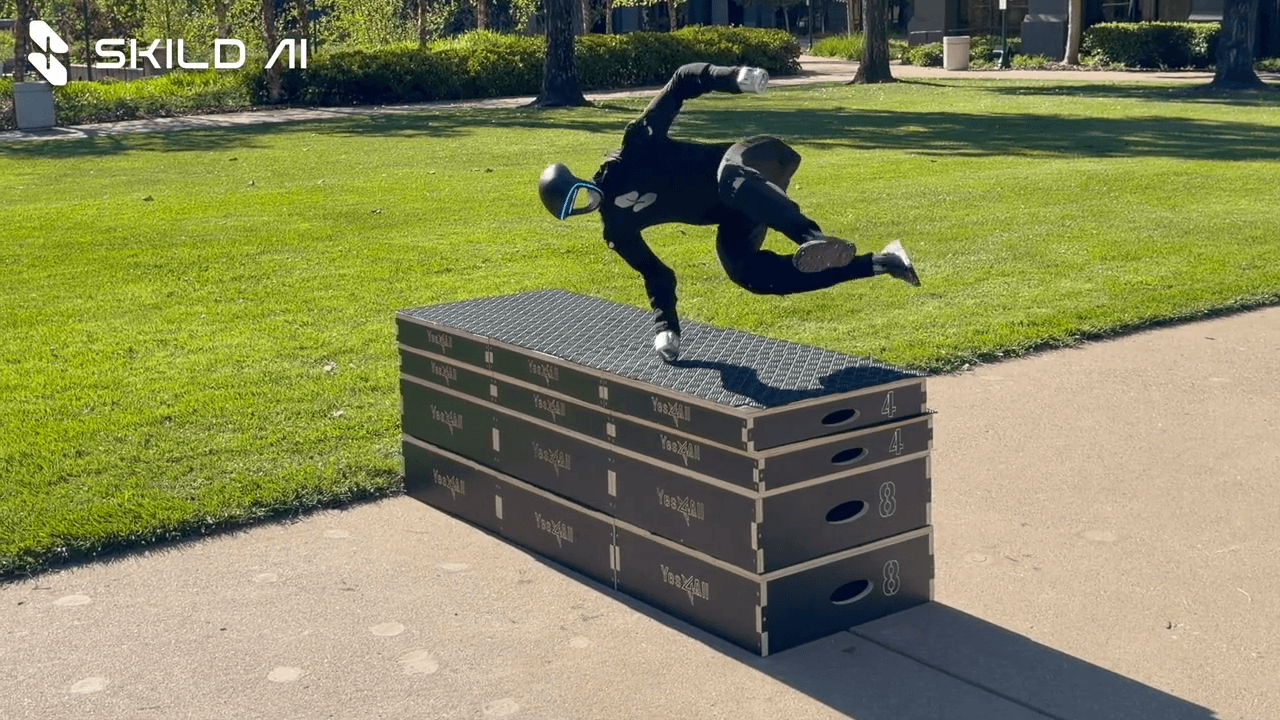
- "Real-Life QWOP": When a robot's leg suddenly breaks or a joint locks, the robot wobbles briefly then creates a new walking pattern on the spot—like a person with an injured leg limping. This decisive moment showed the AI adapting to situations rather than following pre-programmed code.
- Climbing Stairs: A humanoid robot carrying heavy loads up steep stairs, maintaining balance without falling despite being kicked from outside, demonstrated a level of robustness difficult to achieve with traditional control theory.
8. Conclusion and Outlook: The Path to AGI
8.1 Technical Challenges and Prospects
The future Skild AI envisions is bright, but significant hurdles remain. The biggest challenge is safety. Even if simulations succeed 99.9% of the time, that 0.1% failure in the real world could result in loss of life. For robots to coexist with humans in shared spaces, near-perfect reliability must be guaranteed. Additionally, building a "standard interface" perfectly compatible with thousands of different robot hardware types will be a technically and politically arduous process.
8.2 Conclusion: The Awakening of the Physical World
Skild AI has transformed robots from "objects to be programmed" into "learning agents." The vision of scholars Deepak Pathak and Abhinav Gupta was to teach robots "common sense" through simulation and internet data.
In 2025, Skild AI is leading the robotics industry's "Android moment" with massive capital and technical prowess. Their success will determine more than just one company's fate—it will be a crucial touchstone for the arrival of the AGI (Artificial General Intelligence) era, when AI breaks through monitor screens to live alongside us in the physical world. For investors, it's a high-risk, high-return opportunity. For the general public, it's a thrilling vantage point to witness science fiction imagination becoming reality.
References
- Skild AI review (2025): A look at the general-purpose robot brain - eesel AI, accessed December 30, 2025, https://www.eesel.ai/blog/skild-ai-review
- Skild is bringing Generative AI to the real world - Lightspeed Venture Partners, accessed December 30, 2025, https://lsvp.com/stories/skild-is-bringing-generative-ai-to-the-real-world/
- Beyond automation: Physical AI ushers in a new era of smart machines - SiliconANGLE, accessed December 30, 2025, https://siliconangle.com/2025/12/28/beyond-automation-physical-ai-ushers-new-era-smart-machines/
- Skild AI Provides First Look at Its General-Purpose Robotic Brain | RoboticsTomorrow, accessed December 30, 2025, https://www.roboticstomorrow.com/news/2025/07/30/skild-ai-provides-first-look-at-its-general-purpose-robotic-brain/25259/
- One Model, Any Scenario: End-to-end Locomotion from Vision - Skild AI, accessed December 30, 2025, https://www.skild.ai/blogs/one-policy-all-scenarios
- Building the general-purpose robotic brain - Skild AI, accessed December 30, 2025, https://www.skild.ai/blogs/building-the-general-purpose-robotic-brain
- Skild AI Business Breakdown & Founding Story - Contrary Research, accessed December 30, 2025, https://research.contrary.com/company/skild-ai
- Deepak Pathak - The Robotics Institute - CMU, accessed December 30, 2025, https://www.ri.cmu.edu/ri-faculty/deepak-pathak/
- Large-Scale Study of Curiosity-Driven Learning - Deepak Pathak, accessed December 30, 2025, https://pathak22.github.io/large-scale-curiosity/
- Solving generalization and making artificial intelligence curious - GoodAI, accessed December 30, 2025, https://www.goodai.com/solving-generalization-and-making-artificial-intelligence-curious/
- Abhinav Gupta - AI Horizons PGH Summit, accessed December 30, 2025, https://aihorizonspgh.com/team/abhinav-gupta/
- Abhinav Gupta | About - Scholars at Carnegie Mellon University, accessed December 30, 2025, https://scholars.cmu.edu/1663-abhinav-gupta
- How Much Did Skild Raise? Headquarters, Funding & Key Investors - TexAu, accessed December 30, 2025, https://www.texau.com/profiles/skild
- Skild AI Builds Omni-Bodied Robot Brain With NVIDIA, accessed December 30, 2025, https://www.nvidia.com/en-us/customer-stories/skild-ai/
- The case for an omni-bodied robot brain - Skild AI, accessed December 30, 2025, https://www.skild.ai/blogs/omni-bodied
- Skild AI funding, news & analysis | Sacra, accessed December 30, 2025, https://sacra.com/c/skild-ai/
- Skild.ai, accessed December 30, 2025, https://www.skild.ai/
- SoftBank and NVIDIA to Invest in Robotics Innovator Skild AI | Built In, accessed December 30, 2025, https://builtin.com/articles/softbank-nvidia-skild-ai-investment-20251209
- Humanoid Developer Day Conference Sessions | NVIDIA GTC 2025, accessed December 30, 2025, https://www.nvidia.com/gtc/sessions/humanoid-developer-day/
- Skild AI accelerates development of human-like robot brain with AI solutions from Hewlett Packard Enterprise | HPE, accessed December 30, 2025, https://www.hpe.com/us/en/newsroom/press-release/2025/03/skild-ai-accelerates-development-of-human-like-robot-brain-with-ai-solutions-from-hewlett-packard-enterprise.html
- Watts, Water and Workloads: How STN and CoreSite Built the Infrastructure Behind Skild AI at CH2, accessed December 30, 2025, https://www.coresite.com/blog/watts-water-and-workloads-how-stn-and-coresite-built-the-infrastructure-behind-skild-ai-at-ch2
- Nvidia, SoftBank chase robotics brain Skild AI with $1B bet at $14B valuation, accessed December 30, 2025, https://techfundingnews.com/softbank-and-nvidia-plan-1b-investment-in-skild-ai-at-14b-valuation/
- Figure AI Valuation - PM Insights, accessed December 30, 2025, https://www.pminsights.com/companies/figure-ai
- The most advanced robots in 2025 - Standard Bots, accessed December 30, 2025, https://standardbots.com/blog/most-advanced-robot
- Physical Intelligence Company Overview - Grishin Robotics, accessed December 30, 2025, https://www.grishinrobotics.com/post/physical-intelligence-company-overview
- Physical Intelligence valuation, funding & news | Sacra, accessed December 30, 2025, https://sacra.com/c/physical-intelligence/
- Skild AI Raises $300M Series A To Build A Scalable AI Foundation Model For Robotics, accessed December 30, 2025, https://www.businesswire.com/news/home/20240709306400/en/Skild-AI-Raises-%24300M-Series-A-To-Build-A-Scalable-AI-Foundation-Model-For-Robotics
- SoftBank and NVIDIA Back Skild AI with $1 Billion Investment, accessed December 30, 2025, https://www.chosun.com/english/industry-en/2025/12/09/EQF7ZGSXUBD4RBHDSV4CYEGJKY/
- SoftBank, Nvidia to invest in Skild AI at $14 billion valuation - The American Bazaar, accessed December 30, 2025, https://americanbazaaronline.com/2025/12/09/softbank-nvidia-to-invest-in-skild-ai-at-14-billion-valuation-471303/
- Robotics revolution: Skild AI could skyrocket to $14bn with Nvidia and SoftBank backing, accessed December 30, 2025, https://capacityglobal.com/news/robotics-revolution-skild-ai-has-nvidia-and-softbank-backing/
- Skild AI Valuation - PM Insights, accessed December 30, 2025, https://www.pminsights.com/companies/skild-ai
- Buy and Sell figure.ai Stock - 2025 - Join Prospect, accessed December 30, 2025, https://www.joinprospect.com/explore/figure-stock
- Recent demo by Skild AI : r/robotics - Reddit, accessed December 30, 2025, https://www.reddit.com/r/robotics/comments/1o9r2ut/recent_demo_by_skild_ai/