Gemini 4 Argon Benchmarks: Where It Leads and Where It Loses
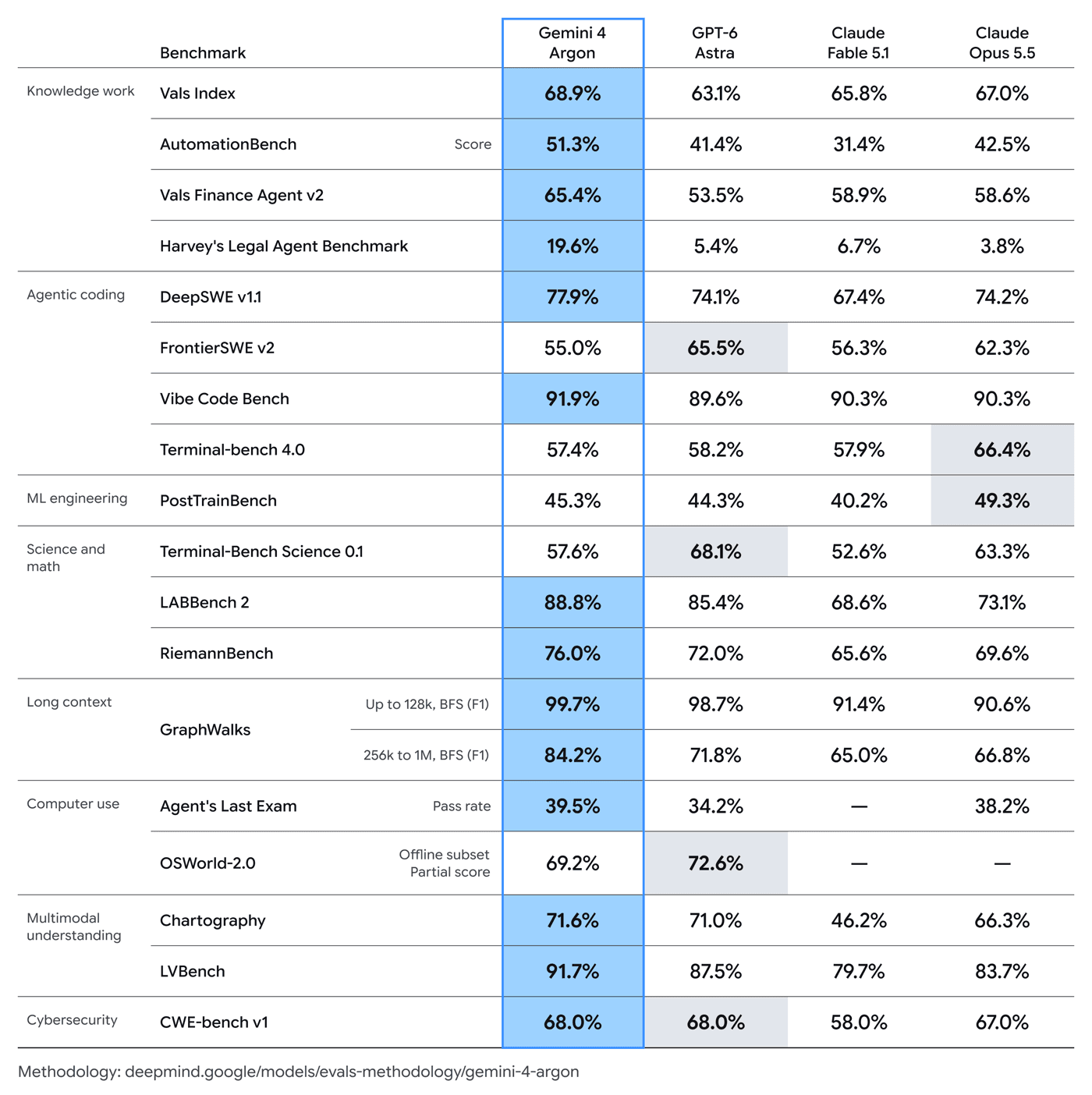
In Google's official Gemini 4 Argon benchmarks, the new frontier model has the top score in 13 of the 19 rows and ties for first in one more. It loses the other five to GPT-6 Astra or Claude Opus 5.5, and on Terminal-bench 4.0 it scores lowest of the four models compared. Independent tests are closer than Google's chart suggests: Vals AI ranks Argon first on its Vals Index, while Artificial Analysis puts it at 53 on its Intelligence Index, level with GPT-6 Astra and Claude Fable 5.1 and behind Claude Opus 5.5. All of those numbers use Argon's highest thinking level. The API defaults to a lower one.
Key takeaways
- In Google's own (vendor-reported) table, Argon is first outright on 13 of 19 rows and tied on CWE-bench v1. Its biggest wins are on knowledge-work agents (Harvey's Legal Agent Benchmark 19.6% vs 6.7% for the next model) and million-token context (GraphWalks 256K to 1M: 84.2% vs 71.8%).
- It loses FrontierSWE v2, Terminal-bench 4.0, PostTrainBench, Terminal-Bench Science 0.1 and OSWorld-2.0. On Terminal-bench 4.0 Argon's 57.4% trails Opus 5.5's 66.4%.
- In independent tests, Vals AI puts Argon first on the Vals Index at 68.90%. Artificial Analysis scores Argon (High) at 53, against 58 for Claude Opus 5.5 at max effort.
- Google ran every Argon score at the highest thinking setting. The
gemini-4-argonAPI model defaults toMEDIUM. - Argon had a limited release on September 30, 2026 and reached the paid API and Google AI Pro/Ultra subscribers on October 13. API pricing is $2/$10 per million input/output tokens through November 30, 2026, then $4/$20.
What Gemini 4 Argon is
Google DeepMind's model card calls Gemini 4 Argon "a new frontier model" that "is not a modification or a fine-tune of a prior model." It is a sparse mixture-of-experts transformer that takes text, images, audio and video and returns text. Input and output share one context window of up to 1 million tokens, and the knowledge cutoff is March 2026 (Gemini 4 Argon model card).
Google is pitching it at long, multi-step work: software engineering, legal and finance tasks, and cybersecurity defense. The Google Cloud developer guide lists the context window as 1,048,576 tokens. A single request returns up to 65,536 output tokens when streaming. A "long decode" mode chains requests with a continuation token so that one answer can use up to the full window, minus the input.
Gemini 4 Argon benchmarks: the official table, row by row
Google published the same table in its September 30 announcement and in the model card. All figures below are vendor-reported. Bold marks the top score in each row.
| Category | Benchmark | Gemini 4 Argon | GPT-6 Astra | Claude Fable 5.1 | Claude Opus 5.5 |
|---|---|---|---|---|---|
| Knowledge work | Vals Index | 68.9% | 63.1% | 65.8% | 67.0% |
| Knowledge work | AutomationBench | 51.3% | 41.4% | 31.4% | 42.5% |
| Knowledge work | Vals Finance Agent v2 | 65.4% | 53.5% | 58.9% | 58.6% |
| Knowledge work | Harvey's Legal Agent Benchmark | 19.6% | 5.4% | 6.7% | 3.8% |
| Agentic coding | DeepSWE v1.1 | 77.9% | 74.1% | 67.4% | 74.2% |
| Agentic coding | FrontierSWE v2 | 55.0% | 65.5% | 56.3% | 62.3% |
| Agentic coding | Vibe Code Bench | 91.9% | 89.6% | 90.3% | 90.3% |
| Agentic coding | Terminal-bench 4.0 | 57.4% | 58.2% | 57.9% | 66.4% |
| ML engineering | PostTrainBench | 45.3% | 44.3% | 40.2% | 49.3% |
| Science and math | Terminal-Bench Science 0.1 | 57.6% | 68.1% | 52.6% | 63.3% |
| Science and math | LABBench 2 | 88.8% | 85.4% | 68.6% | 73.1% |
| Science and math | RiemannBench | 76.0% | 72.0% | 65.6% | 69.6% |
| Long context | GraphWalks, up to 128K (BFS F1) | 99.7% | 98.7% | 91.4% | 90.6% |
| Long context | GraphWalks, 256K to 1M (BFS F1) | 84.2% | 71.8% | 65.0% | 66.8% |
| Computer use | Agent's Last Exam (pass rate) | 39.5% | 34.2% | n/a | 38.2% |
| Computer use | OSWorld-2.0 (offline subset, partial score) | 69.2% | 72.6% | n/a | n/a |
| Multimodal | Chartography | 71.6% | 71.0% | 46.2% | 66.3% |
| Multimodal | LVBench | 91.7% | 87.5% | 79.7% | 83.7% |
| Cybersecurity | CWE-bench v1 | 68.0% | 68.0% | 58.0% | 67.0% |
Source: Google, Gemini 4 Argon model evaluation. "n/a" means Google showed no score for that model.
18 benchmarks or 19?
Coverage disagrees on the count. VentureBeat counted 18 benchmarks, with Argon first outright on 12 and tied on one. DataCamp counted 19 and said Argon leads 13. Both tallies are correct. GraphWalks appears twice in the table, once at up to 128K tokens and once at 256K to 1M. Count it as one benchmark and you get 18; count rows and you get 19. Argon wins both GraphWalks rows.
Where Gemini 4 Argon leads
The widest margins are in knowledge work run through agents. On Harvey's Legal Agent Benchmark, Argon's 19.6% is roughly three times the next score, Fable 5.1's 6.7%. Even so, it fails most of the tasks. On Vals Finance Agent v2 it leads by 6.5 points, and on Zapier's AutomationBench by 8.8 points over Opus 5.5.
Long context is the other standout. With 256K to 1M tokens of input, Argon's 84.2% on GraphWalks is 12.4 points ahead of GPT-6 Astra. Both Claude models land in the mid-60s. If you load whole codebases or long document sets into one prompt, this is the row to look at.
Argon also leads on video understanding (LVBench 91.7%) and on LABBench 2, a biology lab-reasoning test (88.8% vs 85.4% for Astra). On the coding test DeepSWE v1.1 it scores 77.9%, 3.7 points ahead of Opus 5.5.
Where it loses: Terminal-bench and four other rows
Five rows go to competitors, and most involve long agentic sessions in a terminal or a desktop:
| Benchmark | Gemini 4 Argon | Leader | Gap |
|---|---|---|---|
| FrontierSWE v2 | 55.0% | GPT-6 Astra 65.5% | 10.5 pts |
| Terminal-Bench Science 0.1 | 57.6% | GPT-6 Astra 68.1% | 10.5 pts |
| Terminal-bench 4.0 | 57.4% | Claude Opus 5.5 66.4% | 9.0 pts |
| PostTrainBench | 45.3% | Claude Opus 5.5 49.3% | 4.0 pts |
| OSWorld-2.0 (offline) | 69.2% | GPT-6 Astra 72.6% | 3.4 pts |
Terminal-bench 4.0 is the clearest weak spot. Argon is last of the four models there, behind even Fable 5.1 (57.9%), and Opus 5.5 leads by 9 points. Artificial Analysis found the same thing in its own runs: Argon (High) scored 57% on Terminal-Bench 4.0 against 60% for GPT-6 Astra (Xhigh) (Artificial Analysis comparison). If your workload is mostly a coding agent working in a shell, these rows tell you more than the headline.
Which rows are third-party-run
Google's methodology document says how each row was produced. That matters, because a score Google ran on itself is a different kind of evidence from one an outside leaderboard ran.
| Who produced the numbers | Rows |
|---|---|
| Outside party, for all models | Vals Index, Vals Finance Agent v2 and Harvey's Legal Agent Benchmark (Vals AI); AutomationBench (Zapier leaderboard, private set); FrontierSWE (Proximal leaderboard); Vibe Code Bench (Vals AI leaderboard); RiemannBench and Chartography (Surge leaderboard); CWE-bench v1 (official leaderboard) |
| Google, for all models | PostTrainBench, LABBench 2, GraphWalks, LVBench |
| Google for Argon; leaderboards or system cards for rivals | DeepSWE v1.1, Terminal-bench 4.0, Terminal-Bench Science 0.1, Agent's Last Exam, OSWorld-2.0 |
A few footnotes affect how much weight a row can carry:
- On Terminal-Bench Science 0.1, Argon ran with a 6x verifier timeout "to address timeout issues with verification." Competitor scores come from the public leaderboard.
- On OSWorld-2.0, Argon's score is "maxed over 3 runs," and Anthropic's models are left out because Anthropic reports only a combined online-and-offline figure.
- On LVBench, each model saw a different number of video frames (1 frame per second for Gemini, 800 frames for Astra, 300 for Fable 5.1, 600 for Opus 5.5), which Google attributes to API limits.
- Rival scores are mostly the providers' own published numbers, at their maximum reasoning settings where available.
Several of Argon's clear wins (GraphWalks, LABBench 2, LVBench) come from tests Google ran itself. Of the nine rows scored by outside parties, Argon leads seven, ties CWE-bench v1, and loses only FrontierSWE v2.
How independent results compare
Two outside groups had published Argon results by October 16.
Vals AI. On the Vals Index leaderboard (v2.1, updated October 16, 2026), Gemini 4 Argon is first at 68.90%. Next come Claude Sonnet 5.5 (67.04%), Claude Opus 5.5 (66.97%), Claude Fable 5.1 (65.83%) and GPT-6 Astra (63.13%). Vals also lists cost per test: $15.68 for Argon, $32.14 for Opus 5.5, $28.71 for Fable 5.1 and $18.46 for Astra. Sonnet 5.5, which places second, is not in Google's table.
Artificial Analysis. On the Artificial Analysis leaderboard, Gemini 4 Argon (High) scores 53 on the Intelligence Index. That ties it with Claude Fable 5.1 (max) and GPT-6 Astra (max), puts it just above GPT-6 Astra (xhigh) at 52, and leaves it behind Claude Opus 5.5 (max) at 58 and Claude Sonnet 5.5 (max) at 56. TechTimes cites the unrounded figure as 52.56.
In the head-to-head with GPT-6 Astra (Xhigh), Artificial Analysis has Argon ahead on AutomationBench-AA (78% vs 67%), GDPval-AA (1624 vs 1556), SciCode (62% vs 56%) and Humanity's Last Exam (57% vs 55%). Astra is ahead on Terminal-Bench 4.0, GDP.pdf (32% vs 22%) and CritPt (31% vs 27%).
Argon also talks a lot. Artificial Analysis measured 62K output tokens per task for Argon against 17K for Astra, 36K of them reasoning tokens. At introductory prices Argon still costs less per task ($1.99 vs $2.31), and running the whole index cost $2,407 against $3,803. When the list price doubles on December 1, the same token counts would put Argon's cost per task at roughly $4. That is our estimate, not an Artificial Analysis figure.
The thinking-mode caveat: HIGH vs MEDIUM
A thinking level sets how much internal reasoning the model does before it answers; those reasoning tokens are billed as output. Gemini 4 Argon has three: LOW, MEDIUM and HIGH. Per the Google Cloud guide, the standard gemini-4-argon model defaults to MEDIUM. Only gemini-4-argon-cyber-permissive, the variant for approved cybersecurity work, defaults to HIGH.
Google's evaluation says that "all of the results are run with the Gemini API with the highest thinking settings unless indicated otherwise." Artificial Analysis also tested the High setting. TechTimes reports that Gemini app subscribers get MEDIUM by default and warns they "may see a different, and likely lower, capability profile for reasoning-intensive tasks." Nobody has published a MEDIUM score yet, so the size of the gap is unknown.
For developers the fix is to set thinking_level to HIGH on requests where accuracy matters, and to expect more output tokens, and so higher cost, when you do.
Availability timeline and pricing
| Date | What happened |
|---|---|
| September 30, 2026 | Announced. Limited rollout to trusted cyber defenders through the Fairwind Program; broader release promised "as soon as possible" (Google) |
| October 13, 2026 | Paid Gemini API tier worldwide (AI Studio, Android Studio, Gemini platform), Gemini for business, the Gemini app and AI Mode for Google AI Pro and Ultra subscribers, and Antigravity for Ultra (Google) |
| December 1, 2026 | API list price doubles (AI Studio pricing) |
API pricing per million tokens:
| Tier | Input | Output (incl. thinking) | Cached input |
|---|---|---|---|
| Standard, through Nov 30, 2026 | $2.00 | $10.00 | $0.10 |
| Standard, from Dec 1, 2026 | $4.00 | $20.00 | $0.20 |
| Batch and Flex, through Nov 30 | $1.00 | $5.00 | $0.05 |
| Batch and Flex, from Dec 1 | $2.00 | $10.00 | $0.10 |
Argon is not on the Gemini API free tier, and only implicit caching is supported. For comparison, VentureBeat lists GPT-6 Astra and Claude Fable 5.1 at $10/$50 and Claude Opus 5.5 at $4/$20. Argon's introductory price is a fifth of Astra's. From December it matches Opus 5.5.
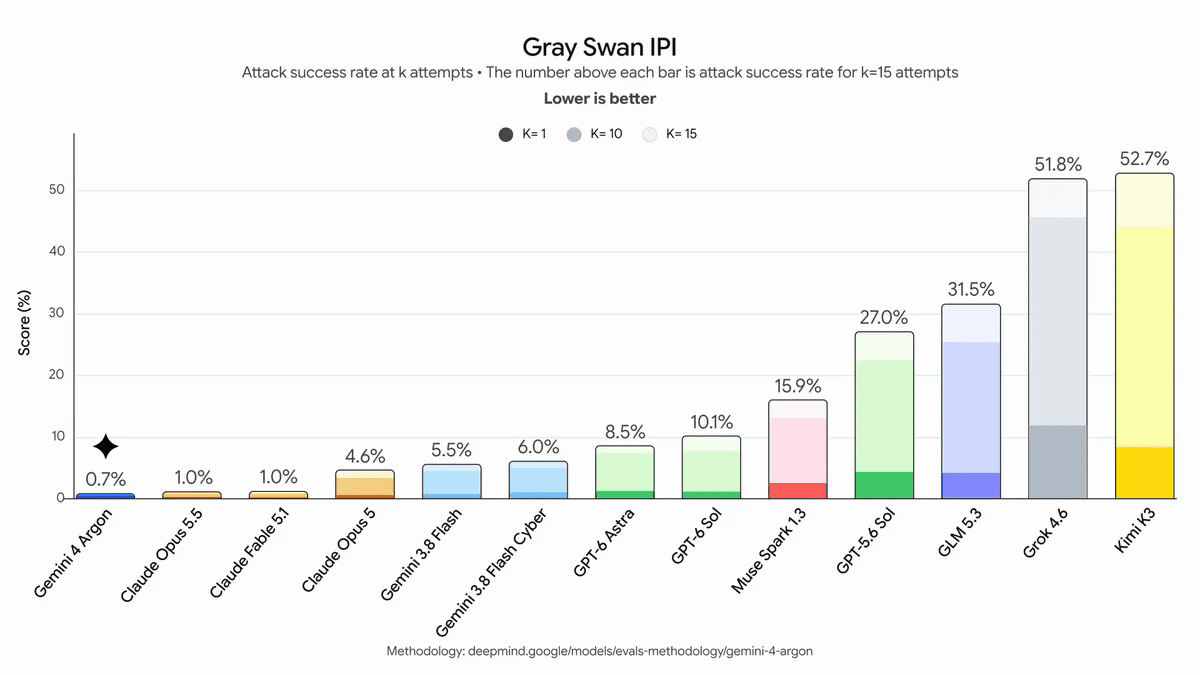
Safety is part of the pitch too. On Gray Swan's indirect prompt-injection benchmark, attacks succeeded 0.7% of the time against Argon after 15 attempts, compared with 1.0% for both Claude models and 8.5% for GPT-6 Astra. The model card also says Google "cannot rule out" that Argon reaches its critical capability levels for biological and cyber risk, and that it has added safeguards in response.
What it means for developers choosing a model
- For long-context and document-heavy agents, Argon has the best case. The GraphWalks lead is large, the 1M-token window is shared across input and output, and long decode lets one response run to hundreds of thousands of tokens.
- For legal, finance and business automation, the Vals and Zapier rows were run outside Google, and Argon leads all of them. Vals also measured it as cheaper per test than the Claude models.
- For terminal-heavy coding agents, look closely at Claude Opus 5.5 and GPT-6 Astra. Argon is last on Terminal-bench 4.0 in Google's table and behind Astra in Artificial Analysis's run.
- For budgeting, use the December rates, set the thinking level yourself, and measure output tokens on your own tasks. Argon's lead in some tests comes with heavy token use.
If you are also weighing open-weight options, see our breakdown of Meta's Muse Spark Open.
FAQ
Is Gemini 4 Argon better than GPT-6 Astra and Claude Opus 5.5?
On Google's own table, Argon has the top score in 13 of 19 rows. Independent results are closer. Vals AI ranks it first on the Vals Index (68.90%). Artificial Analysis scores it 53, tied with GPT-6 Astra (max) and behind Claude Opus 5.5 (max) at 58. It depends on the task: Argon leads on long context and knowledge work, and trails on terminal-based coding.
Why does Gemini 4 Argon score lower on Terminal-bench 4.0?
Google has not explained it. Its table shows Argon at 57.4%, below GPT-6 Astra (58.2%), Claude Fable 5.1 (57.9%) and Claude Opus 5.5 (66.4%). Google ran Argon's score itself and took the others from the public leaderboard. Artificial Analysis's separate run also has Argon behind Astra, 57% to 60%.
What thinking level do the Gemini 4 Argon benchmarks use?
Google says all Argon results use the highest thinking setting, and Artificial Analysis tested "High." The standard gemini-4-argon API model defaults to MEDIUM, so developers who want benchmark-level reasoning should set HIGH explicitly.
How much does Gemini 4 Argon cost?
On the paid Gemini API tier, $2 per million input tokens and $10 per million output tokens (thinking tokens included) through November 30, 2026. From December 1, 2026 it is $4 and $20. Batch and Flex cost half. There is no free API tier for Argon.
Who can use Gemini 4 Argon now?
Since October 13, 2026: paid Gemini API users worldwide, Gemini for business customers, and Google AI Pro and Ultra subscribers in the Gemini app and AI Mode. Ultra subscribers also get it in Google Antigravity and AI Studio. Before that it was limited to Fairwind Program cyber defenders and internal teams.
Sources
- Google: Gemini 4 Argon announcement (Sept 30, 2026)
- Google: Introducing Gemini 4 Argon, availability (Oct 13, 2026)
- Google DeepMind: Gemini 4 Argon model card
- Google DeepMind: Gemini 4 Argon model evaluation methodology
- Google Cloud: Developer's guide to Gemini 4 Argon
- Google AI Studio: Gemini API pricing
- Vals AI: Vals Index leaderboard
- Artificial Analysis: models leaderboard
- Artificial Analysis: Gemini 4 Argon vs GPT-6 Astra (Xhigh)
- VentureBeat: Google unveils Gemini 4 Argon
- TechTimes: Gemini 4 Argon benchmark scores reflect HIGH mode
- DataCamp: Gemini 4 Argon