Genie 4: Google DeepMind's World Model with Native Audio

Google DeepMind announced Genie 4 on October 27, 2026. It is a world model: you describe a place, and it generates an explorable scene in real time that you can walk through with the keyboard and change by typing. What's new is sound. DeepMind calls Genie 4 its "first real-time world model to generate audio natively," so ambient noise, music and character dialogue come out of the same model as the picture (Google DeepMind).
For now it is a research preview for trusted testers. DeepMind says access is "coming soon" to Google AI Ultra subscribers through Project Genie and to early access partners on the Gemini API and Google AI Studio. It has not published resolution, frame rate, session length or pricing.
Key takeaways
- Genie 4 renders interactive worlds in real time and generates audio with them: ambient sound, music and dialogue that changes with what happens in the scene.
- Gemini models do part of the work. Gemini Omni keeps scenes grounded in how the real world looks and behaves, and Gemini 3.8 Flash can act as a guiding agent that plans and checks steps during generation.
- You can steer a running world with plain language: change the weather, move the camera, add people or objects.
- Access today is limited to trusted testers. Project Genie (for Google AI Ultra) and the Gemini API are next, with no date given.
- Every generated video and audio track carries a SynthID watermark.
- DeepMind lists drift over long sessions, legible text, spatial accuracy and audio accuracy as open problems.
What is Genie 4?
A world model is an AI system that predicts how an environment changes over time and in response to actions. Instead of rendering a fixed video clip, it produces the next frames on the fly as you move, so the world reacts to input the way a game engine would, except nothing is pre-built.
Genie 4 is the fourth model in DeepMind's Genie line. Genie 3, announced on August 5, 2025, ran at 720p and 24 frames per second, kept a world consistent for "a few minutes," and remembered what it had shown for up to about a minute (Google DeepMind, Genie 3). Genie 4 keeps that real-time, keyboard-driven setup and pushes on three fronts, according to the announcement: more photorealism, more fluid movement of people and objects, and native audio.

What's new in Genie 4
Sound and dialogue from the same model
Earlier Genie models were silent. Genie 4 produces music, ambient noise and "interactive dialogue that adapts on the fly." In one of DeepMind's demos, a station attendant on a rural Japanese platform walks toward the camera and announces the next departure; in another, a piano duet plays on an island. Because sound is generated with the frames rather than added afterward, footsteps, wind and speech can follow what the user does.

Steering a world while it runs
You can change a world mid-session with natural language: switch the weather, move the camera, or drop in new people and objects. DeepMind says Gemini adapts the prompt to fit the current scene. Navigation uses standard keyboard controls. The demos also show reference images used as the first frame, which is how a 2D photograph becomes a place you can walk into.
Gemini inside the loop
DeepMind describes three ways Gemini models plug into Genie 4:
- Gemini Omni anchors simulations in real-world appearance and behavior, and other Gemini models handle reasoning for coherence and continuity.
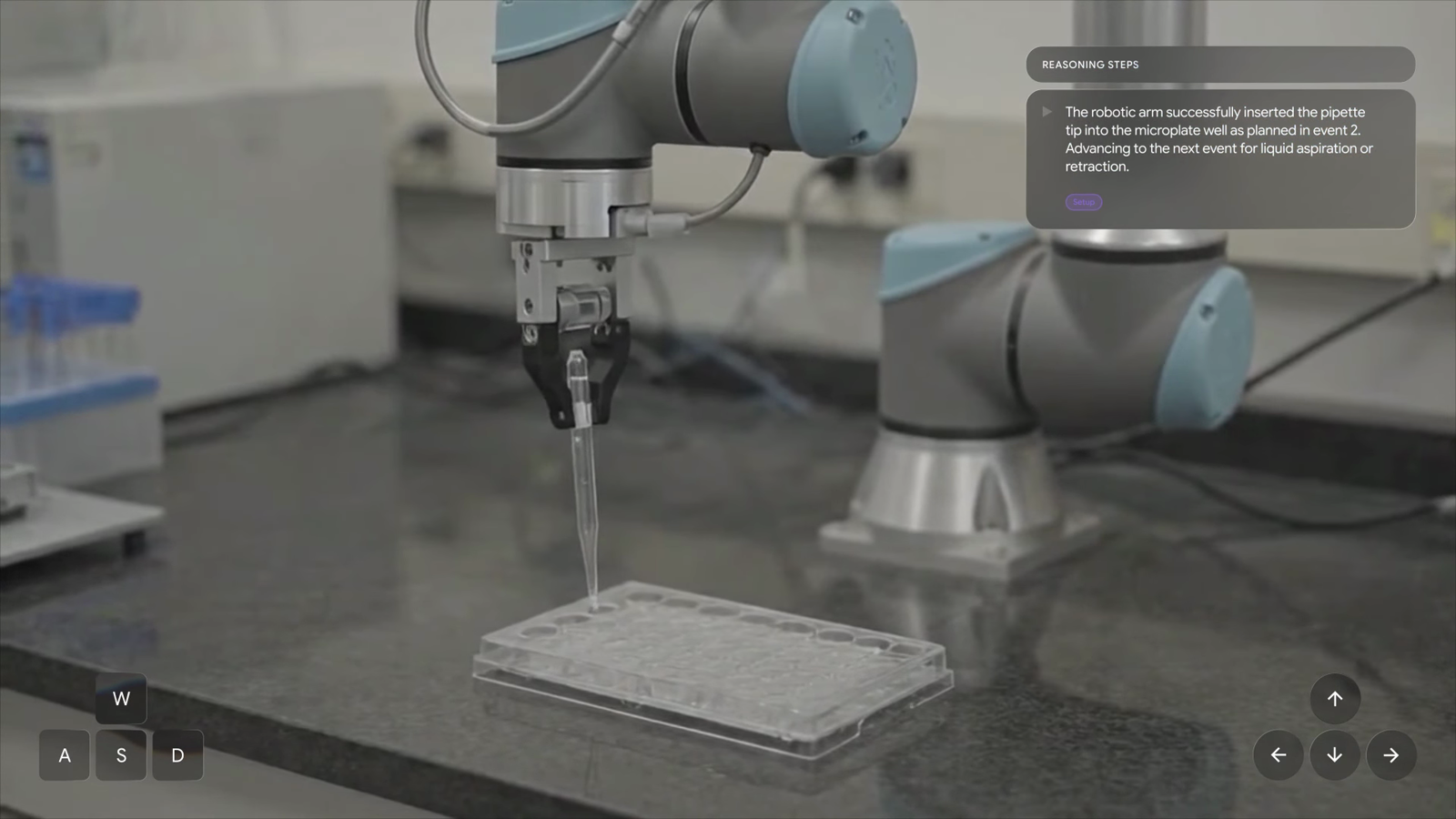
- Gemini 3.8 Flash can run as a guiding agent during generation. It watches the scene, breaks a goal into steps, checks whether each step worked, and changes the plan when the world shifts or the user steps in.
- In an experiment, Gemini 4 Argon fed task steps as text captions to Genie 4 while it rendered. The example shows an Apptronik Apollo humanoid robot playing checkers. We covered Argon's strengths and weak spots in our Gemini 4 Argon benchmark post.
Physics and people
DeepMind says Genie 4 simulates aerodynamics and collisions, and that characters "move naturally, respond organically to their environments, and can be interactively steered in real-time." Demo prompts include a falling maple seed, a silk scarf and a hot-air balloon.
Genie 3 vs Genie 4 vs Project Genie today
| Genie 3 | Project Genie (today) | Genie 4 | |
|---|---|---|---|
| Announced | August 5, 2025 | January 29, 2026 | October 27, 2026 |
| What it is | Research world model | Google Labs web app built on Genie 3 | Research world model |
| Audio | None | None | Native: ambient, music, dialogue |
| Published specs | 720p, 24 fps, a few minutes of consistency | 60-second sessions | No resolution, fps or session length published |
| Gemini role | Not described | Gemini and Nano Banana Pro help build worlds | Gemini Omni grounding, Gemini 3.8 Flash guiding agent |
| Who can use it | Limited research preview | Google AI Ultra subscribers, 18+ | Trusted testers; Ultra and API "coming soon" |
Sources: Genie 3 announcement, Project Genie help page, TechCrunch, Genie 4 announcement.
How to get access to Genie 4
There is no public way to use Genie 4 yet. DeepMind lists three routes:
- Trusted testers, in the current preview. DeepMind names filmmakers, game developers and enterprise partners among the groups testing it.
- Project Genie for Google AI Ultra subscribers. Project Genie is Google's experimental world-building app. It launched on January 29, 2026 for US AI Ultra subscribers on Genie 3, Nano Banana Pro and Gemini (TechCrunch). Google's help page now says it is available wherever Google AI Ultra is offered, to users 18 and older, with 60 seconds to explore each world. Genie 4 is listed as coming to it, and a waitlist is open.
- The Gemini API and Google AI Studio, for early access partners first. No pricing or rate limits have been published.
If you already use Project Genie, expect the 60-second cap and the Genie 3 behavior to stay until Google announces the switch.
What testers are using it for
DeepMind describes four early use cases:
- Creative direction: a fast "draft mode" for previsualization, so a director can block out a scene before shooting.
- Historical and archival work: turning a 2D photograph into a space you can move through.
- Game concept design: prototyping a level or mood from a text prompt.
- Simulation: "zero-to-one" scenario generation, including for robotics, where a world model can produce training situations that are rare or expensive to stage in reality.
Robotics gets the most space in the announcement. A world model that holds physics and objects steady could let an AI agent rehearse a task in simulation before a robot tries it, and the Argon and Apollo experiment is a first test of that idea.
Limits and safety
DeepMind is direct about what still breaks. Visual details and object permanence "can shift or drift over time," especially in longer sessions, after several prompt edits, or while moving around. Complex physical interactions, real-time audio accuracy, legible text, spatial accuracy and long-term consistency are listed as active research areas. Text rendering and session length were already on Genie 3's list of limitations in 2025.
Earlier hands-on reports on Project Genie give a sense of the gap between demos and use. TechCrunch's reviewer found photorealistic prompts often looked like video games, saw characters walk through walls, and had keyboard input go the wrong way at times (TechCrunch). That was Genie 3. Whether Genie 4 fixes those issues will only be clear once people outside the tester group can try it.
On safety, DeepMind says Genie 4 ships with guardrails consistent with its other models, went through internal evaluations before the preview, and went to trusted testers first. All generated video and audio include SynthID, Google's invisible watermark for AI-generated media.
Why it matters
A video generator gives you a clip to watch; a world model gives you a place to act in. Native sound makes Genie 4 scenes feel less like silent renders, and the Gemini agents in the loop make it a sandbox where AI systems can plan, act and check results. If world models keep physics and objects consistent for longer, they become a cheap way to test agents and robots before anything happens in the real world.
DeepMind has not said what resolution or frame rate Genie 4 runs at, how long a session can last, or what it will cost. Until it does, Genie 4 is a set of impressive demos and a waitlist.
FAQ
What is Genie 4?
Genie 4 is a real-time world model from Google DeepMind, announced on October 27, 2026. It turns text prompts or a reference image into an interactive environment you can explore with the keyboard and change with natural language, and it generates matching audio, including dialogue.
Can I use Genie 4 now?
Not unless you are a trusted tester. DeepMind says Genie 4 is coming to Google AI Ultra subscribers through Project Genie and to early access partners on the Gemini API and Google AI Studio, with a waitlist through Project Genie.
How is Genie 4 different from Genie 3?
Genie 4 adds natively generated audio (ambient sound, music and adaptive dialogue), more photorealism, more fluid motion, and tighter integration with Gemini models that plan and verify steps. Genie 3 ran at 720p and 24 fps; DeepMind has not published equivalent specs for Genie 4.
Is Genie 4 free?
No price has been announced. Project Genie, where Genie 4 is expected to appear first for consumers, requires a Google AI Ultra subscription.
How can you tell Genie 4 output is AI-generated?
DeepMind says all video and audio generated by Genie 4 carries SynthID, Google's invisible watermark for AI-generated content.
Sources
- Google DeepMind: Genie 4, a new generation of world simulation
- Google DeepMind: Genie 3, a new frontier for world models
- Google Labs Help: Get started with Project Genie
- TechCrunch: I built marshmallow castles in Google's new AI world generator
- Unite.AI: Google DeepMind rolls out Genie 4 world model in research preview