Meta Q3 2026 Earnings: Capex Turns Free Cash Flow Negative
Meta's free cash flow turned negative in the third quarter of 2026. The company spent $34.91 billion on capital expenditures and generated $32.79 billion of operating cash, leaving free cash flow at minus $2.12 billion, according to its October 21 earnings release. Revenue still grew 26% to $64.60 billion, so the ad business is not the problem. The gap comes from the AI build-out: Meta expects $135 billion to $145 billion of capital spending this year and says it will keep "investing aggressively" in 2027.
Investors reacted badly. Shares had risen as much as 5% after hours on October 21, Fortune reported, then fell nearly 7% the next day, according to CNBC.
Key takeaways
- Q3 2026 revenue was $64.60 billion, up 26% year over year. Ad impressions rose 10% and the average price per ad rose 14%.
- Capex, including finance lease principal payments, was $34.91 billion against $32.79 billion of operating cash flow, so free cash flow was minus $2.12 billion (plus $10.63 billion a year earlier).
- Operating income fell 37% to $12.99 billion, mainly because of a $9.89 billion legal charge. Without it, operating income would have been $22.88 billion.
- The 2026 capex range is now $135 billion to $145 billion, narrowed from $130 billion to $145 billion. Meta spent $72.22 billion in 2025.
- Long-term debt rose to $80.92 billion from $58.74 billion at the end of 2025, and Meta bought back no stock in the first nine months of 2026.
- Meta gave no 2027 capex number. Executives said budget planning is at an early stage and the full outlook will come with fourth-quarter results.
What happened to Meta's free cash flow in Q3 2026?
Free cash flow is the cash a company's operations produce after paying for buildings and equipment. Meta defines it as operating cash flow minus purchases of property and equipment minus principal payments on finance leases. In Q3 2026 that worked out to $32.79 billion less $34.91 billion of combined capex and lease payments, or minus $2.12 billion.
| Metric | Q3 2026 | Q3 2025 | Change |
|---|---|---|---|
| Revenue | $64.60B | $51.24B | +26% |
| Costs and expenses | $51.61B | $30.71B | +68% |
| Operating income | $12.99B | $20.54B | -37% |
| Operating margin | 20% | 40% | -20 points |
| Operating cash flow | $32.79B | $30.00B | +9% |
| Free cash flow | -$2.12B | $10.63B | Turned negative |
Source: Meta Q3 2026 earnings release (Form 8-K, Exhibit 99.1).
Several outlets, including 24/7 Wall St., called it Meta's first negative free-cash-flow quarter since 2012, its IPO year. Facebook's own 2012 filings show negative quarters soon after it listed in May of that year, so "first since 2012" is accurate and "first ever as a public company" is not.
The operating cash line is still growing. What changed is the spending side: Meta's quarterly capex is now larger than the cash its apps generate in a quarter.
The $9.89 billion legal charge
Part of the profit drop has nothing to do with AI. Meta recorded a $9.89 billion charge in general and administrative expenses tied to an August 2026 agreement with 52 attorneys general to resolve litigation over teen mental health and social media, with payments of up to about $18.59 billion. Excluding the charge, operating income would have been $22.88 billion and diluted earnings per share $7.40, against the reported $3.83.
Where the AI money goes
Meta's guidance for 2026 capex has risen through the year. It started at $115 billion to $135 billion in January, and on October 21 it was narrowed to $135 billion to $145 billion. At the midpoint, that is about $140 billion, nearly double the $72.22 billion Meta spent in 2025, according to its Q4 2025 release.
The money goes mostly to data centers, servers and network gear for training and running Meta's AI models. On the earnings call, Mark Zuckerberg described Meta's Muse assistant as "very compute intensive" and tied the spending to the company's goal of "personal superintelligence," according to call transcripts published by Motley Fool. CFO Susan Li said Meta aims to "improve compute cost efficiency by more than tenfold over the next year." Fortune reported that Muse Wonder is Meta's first frontier model from this effort. Our earlier piece on Meta's Muse Spark open-weight release covers the smaller end of that model family.
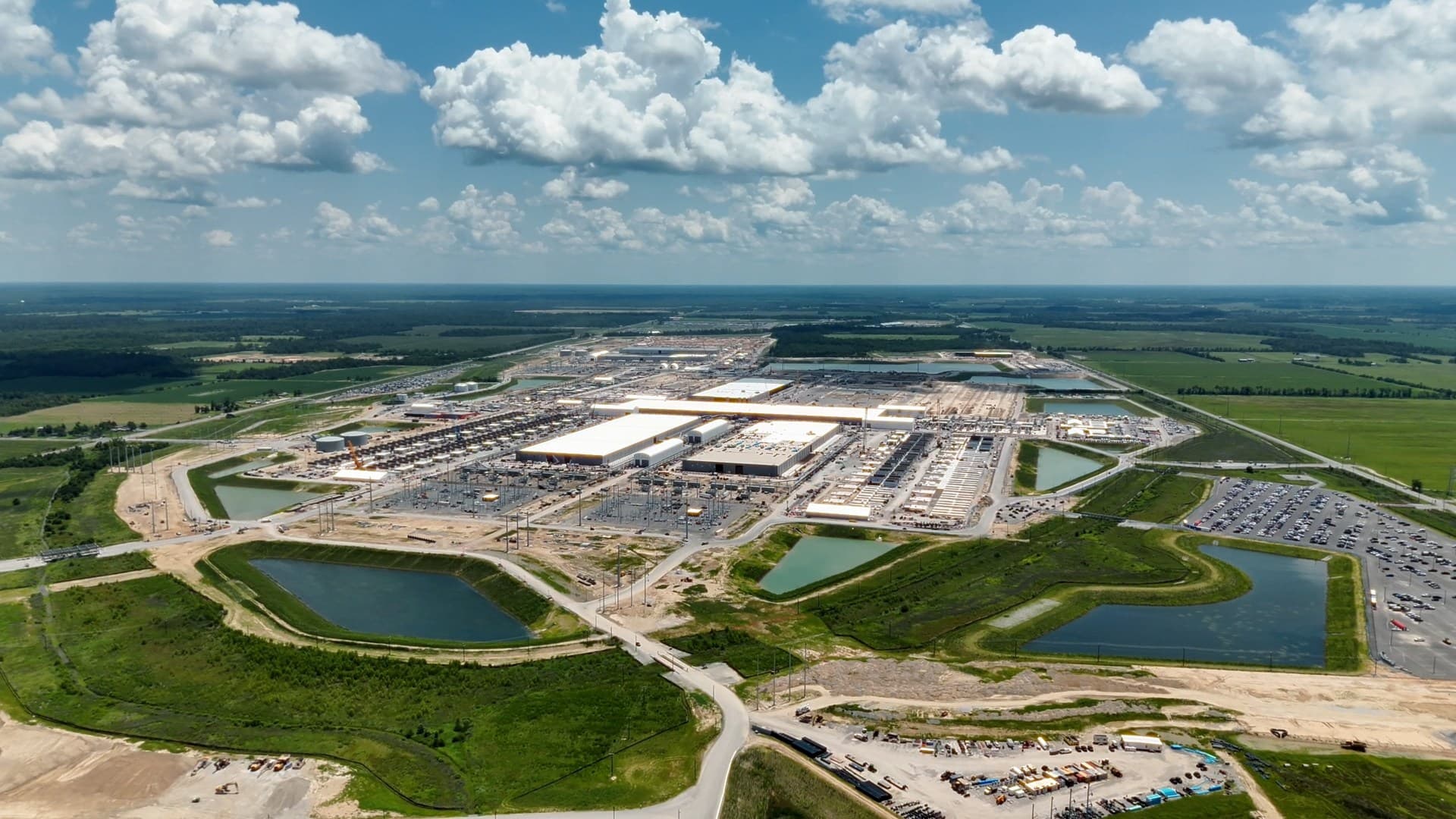
The largest single project is in Richland Parish, Louisiana. In July 2026 Meta said it would expand that campus to 5 gigawatts of compute capacity, the largest in its fleet, with more than $50 billion invested in the region, according to Meta's data center site.
How Meta is paying for it
With cash flow from operations no longer covering capex, Meta is leaning on three other sources.
- Bonds. Meta issued $25 billion of notes in May 2026, according to its Q3 2026 10-Q. Long-term debt reached $80.92 billion on September 30, up from $58.74 billion at the end of 2025. Cash, cash equivalents and marketable securities stood at $82.45 billion.
- Joint ventures kept off the balance sheet. Meta owns 20% of two data center ventures that it does not consolidate. The Louisiana project with Blue Owl Capital, announced in October 2025, has about $27 billion of development costs; an El Paso, Texas, venture with BlackRock, announced in July 2026, covers a 1 GW site costing about $14 billion. The 10-Q puts Meta's maximum exposure to loss on these ventures at $68.40 billion, including $41.49 billion of residual value guarantees.
- Less money returned to shareholders. Meta repurchased no shares in the first nine months of 2026, compared with $3.33 billion in Q3 2025 alone. It still paid $1.36 billion in dividends in the quarter.
A residual value guarantee is a promise to cover the shortfall if a leased asset, here a data center, is worth less than an agreed amount when the lease ends. It does not show up as debt, but it is a real obligation if the assets lose value.
The 10-Q also lists $454.52 billion of non-cancelable contractual commitments and about $355.73 billion of leases that have been signed but have not yet started.
How Meta's AI spending compares with Big Tech peers
Alphabet, Microsoft and Amazon have not reported Q3 2026 yet, so their latest capex guidance is from late July.
| Company | Latest 2026 capex guidance | When given | Next report |
|---|---|---|---|
| Meta | $135B to $145B | October 21, 2026 | Reported |
| Alphabet | $195B to $205B, raised from $180B to $190B | July 22, 2026 | October 28 |
| Amazon | About $220B, raised from $200B | July 30, 2026 | October 29 |
| Microsoft | Fiscal 2027 capex to grow from fiscal 2026 (fiscal year ends in June) | July 29, 2026 | October 28 |
Meta's range is below Alphabet's and Amazon's, but Meta has no cloud business renting computing to outside customers. Alphabet, Amazon and Microsoft can earn back part of their data center spending by selling capacity to other companies; Meta has to earn it back through its own apps and ads. That is one reason similar spending weighs more heavily on Meta's free cash flow.
What Meta said about 2027
Meta gave no 2027 capex or expense figure. Zuckerberg said the company is "quite early in developing our budget and capacity plans for next year," and Li said the full outlook will come with fourth-quarter results, according to the call transcripts. The release itself says Meta expects to "sustain strong overall revenue growth throughout 2027" and to "continue investing aggressively to support both our core business and emerging AI initiatives."
Two other numbers point to where the spending shifts. Reality Labs, the AR and VR unit, lost $4.13 billion in Q3 and should lose $18 billion to $19 billion in 2026, falling to about $15 billion in 2027 as investment moves toward AI. And headcount was 66,775 on September 30, down 15% from a year earlier.
What to watch next
- Alphabet and Microsoft report on October 28, and Amazon on October 29. Their capex guidance will show whether Meta's spending is typical or an outlier.
- Meta's fourth-quarter report, which Meta usually releases in late January, should include the first 2027 capex and expense ranges.
- The Q4 revenue outlook is $73 billion to $76 billion, and 2026 total expenses are guided at $175 billion to $179 billion including the legal charge.
FAQ
Why was Meta's free cash flow negative in Q3 2026?
Meta's capital expenditures, including finance lease principal payments, were $34.91 billion in Q3 2026, more than the $32.79 billion of cash its operations generated. The result was free cash flow of minus $2.12 billion, compared with plus $10.63 billion a year earlier. Most of the spending went to AI data centers and servers.
How much will Meta spend on capex in 2026?
Meta expects 2026 capital expenditures of $135 billion to $145 billion, including principal payments on finance leases. That range was narrowed from $130 billion to $145 billion on October 21, 2026. Meta spent $72.22 billion in 2025, so the midpoint is nearly double.
Did Meta give 2027 spending guidance?
No. Meta said it is early in its 2027 budget planning and will give the full outlook with fourth-quarter results. Its release says it expects to keep "investing aggressively" in its core business and AI in 2027, and that Reality Labs losses should narrow to about $15 billion.
Is this Meta's first negative free cash flow quarter?
It is the first since 2012. Facebook went public in May 2012 and, under the company's current definition, reported negative free cash flow in the quarters right after its IPO. Coverage that calls Q3 2026 the first negative quarter "as a public company" is wrong.
How is Meta financing its AI data centers?
Through operating cash, bond issuance ($25 billion in May 2026), and joint ventures with Blue Owl Capital and BlackRock that keep data center assets off its balance sheet. Meta also stopped buying back shares in 2026. Long-term debt reached $80.92 billion at the end of September.
Sources
- Meta: Third Quarter 2026 Results press release
- SEC: Meta Q3 2026 Form 8-K, Exhibit 99.1
- SEC: Meta Q3 2026 Form 10-Q
- SEC: Meta Q4 2025 results, Exhibit 99.1
- Motley Fool: Meta Q3 2026 earnings call transcript
- Fortune: Meta Q3 earnings, capex and Muse
- CNBC: Meta stock after Q3 earnings
- Meta: Deepening our investment in Richland Parish, Louisiana
- Meta: Hyperion joint venture with Blue Owl Capital
- Meta: El Paso data center venture with BlackRock
- CNBC: Alphabet Q2 2026 earnings
- Fortune: Amazon raises 2026 capex
- CFO Dive: Microsoft holds the line on AI spending plans
This article is for informational purposes only and is not investment advice. Do your own research before making investment decisions.