Recursive Flint: 40B Local Coding Model, Benchmarks

Recursive Flint is an open-weight coding model with 39.8 billion total parameters and about 2.5 billion active per token, released under Apache 2.0 on October 21, 2026. Recursive reports 89.7% on SWE-bench Pro v2, 74.2% on SWE-bench Verified and 54.9% on Terminal-Bench 2.1, and says it runs at more than 125 tokens per second on an M4 Pro MacBook Pro. That puts a capable coding agent on a 48 GB laptop. The catch is that a larger dense model, Qwen 3.8, still beats it on the two hardest agentic tests in Recursive's own chart.
Flint is also the first public model from Recursive, which says a small team built it from scratch in under four months with help from its "Eureka Machine," a system for automated AI research and development. The weights are on Hugging Face, and on October 23 it ranked third on the site's trending models list.
Key takeaways
- Flint has 39.8B total parameters and about 2.5B active per token (about 2.2B for the model body alone), with 256 routed experts and 6 picked per token.
- Recursive reports 89.7% on SWE-bench Pro v2, 74.2% SWE-bench Verified, 54.9% Terminal-Bench 2.1, 80.3% LiveCodeBench v6.
- The weights are licensed under Apache 2.0.
- Recursive's
recengine targets Apple M4 Pro, M5 Pro and M5 Max Macs with at least 48 GB of memory; Recursive reports 1.4 to 2.6 times llama.cpp's throughput on M4 Pro. - On servers, the BF16 checkpoint is about 80 GB and runs on one B300 or H200 GPU per replica with SGLang.
- The dense Qwen 3.8 scores higher on Terminal-Bench 2.1 and SWE-bench Pro v2. Flint's case rests on speed per active parameter.
What is Recursive Flint?
Flint is a decoder-only mixture-of-experts (MoE) Transformer built for coding agents. A mixture-of-experts model splits most of its layers into many small sub-networks called experts and routes each token through only a few of them, so the compute per token tracks the active parameters (2.5B here) while the knowledge capacity tracks the total (40B). The model card describes the job as investigating codebases, fixing bugs, implementing features and writing tests, with reasoning and multi-turn tool use.
The architecture details from the model card:
| Property | Flint |
|---|---|
| Total parameters | 39.8B |
| Active parameters per token | About 2.5B, including the output head |
| Layers | 49: 2 dense, then 47 MoE |
| Experts | 256 routed per MoE layer, 6 selected per token, plus 1 shared expert |
| Attention | 35 sliding-window layers (513-token window) and 14 full-attention layers |
| Heads | 32 query, 4 key/value, head dimension 128 |
| Context | 262,144 tokens documented, prompt and output combined |
| Vocabulary | 150,144 tokens |
| Knowledge cutoff | June 2026 |
| License | Apache 2.0 |
The mix of sliding-window and full-attention layers is what keeps long contexts affordable: most layers only look at the last 512 tokens, and 14 layers see the whole sequence. The launch post says Flint supports up to 512K tokens of context, with 256K recommended for best results; the model card documents the 262,144-token configuration.
How Recursive built Flint
Flint was trained from scratch through pretraining, mid-training, supervised fine-tuning and reinforcement learning, according to the model card. The unusual part is how the design was chosen. Recursive says its Eureka Machine proposed, implemented and tested ideas across data, training recipes, infrastructure and inference. Starting from a 35B-total, 3B-active baseline, it explored expert counts and widths and landed on the 40B / 2.5B design.
Two of those choices stand out:
- A 4-bit output head. Most quantized models keep the final output layer (lm_head) at higher precision. Recursive quantized it to 4 bits and used an offline distillation stage, with the 16-bit model as teacher, that it says nearly halved training steps compared with a quantization-aware training baseline. The released NVFP4 model lands within 0.7 points of the 16-bit model across the benchmarks.
- Custom kernels for Macs. The Eureka Machine also produced kernels, including a Metal "megakernel" for M4 and M5 chips that fuses the entire decode pass into one GPU program.
Recursive has not published a paper on the Eureka Machine, so the claim that automated research shaped the model rests on the company's description for now.
Flint benchmarks vs Qwen, Laguna, Muse Glimmer and Gemma
SWE-bench Verified and SWE-bench Pro ask a model to resolve real GitHub issues inside a repository and pass its tests; Terminal-Bench scores tasks an agent completes in a command-line environment. Recursive's chart compares Flint against local models that run on similar hardware: sparse MoE models with 33B to 35B total and 3B active parameters (Qwen 3.5, Qwen 3.6, Laguna XS 2.1), and dense models of 27B to 31B (Qwen 3.8, Muse Glimmer, Gemma 4).
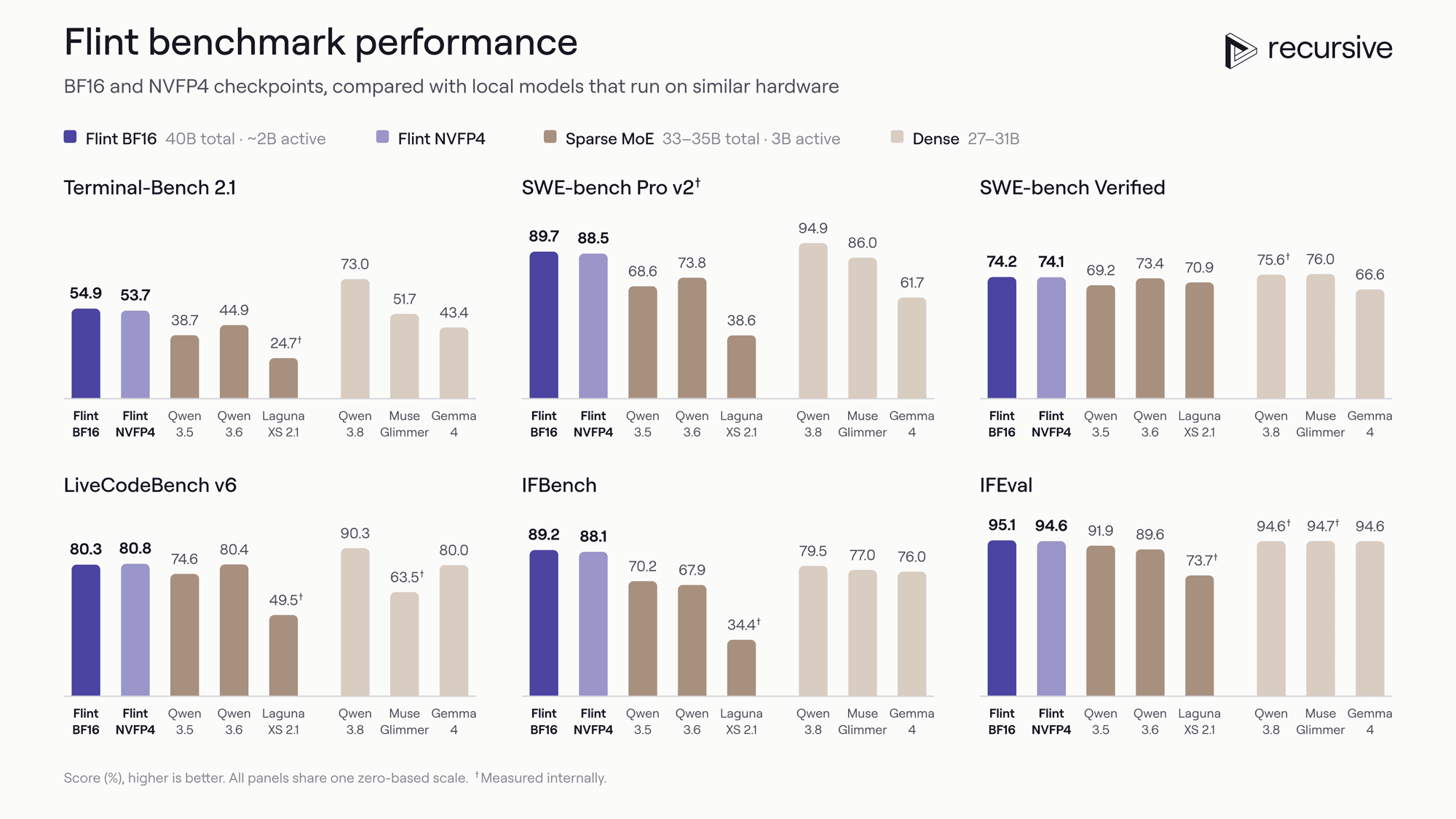
| Benchmark | Flint BF16 | Flint NVFP4 | Qwen 3.6 (MoE) | Qwen 3.8 (dense) | Muse Glimmer (dense) | Gemma 4 (dense) |
|---|---|---|---|---|---|---|
| Terminal-Bench 2.1 | 54.9 | 53.7 | 44.9 | 73.0 | 51.7 | 43.4 |
| SWE-bench Pro v2 | 89.7 | 88.5 | 73.8 | 94.9 | 86.0 | 61.7 |
| SWE-bench Verified | 74.2 | 74.1 | 73.4 | 75.6 | 76.0 | 66.6 |
| LiveCodeBench v6 | 80.3 | 80.8 | 80.4 | 90.3 | 63.5 | 80.0 |
| IFBench | 89.2 | 88.1 | 67.9 | 79.5 | 77.0 | 76.0 |
| IFEval | 95.1 | 94.6 | 89.6 | 94.6 | 94.7 | 94.6 |
Scores in percent, read from Recursive's chart on the model card. Some comparison scores were measured by Recursive; others are developer-reported.
Three readings of this table:
- Against other small MoE models, Flint leads clearly. It beats Qwen 3.6 by 10 points on Terminal-Bench 2.1 and 16 points on SWE-bench Pro v2 with fewer active parameters.
- Against dense models, the result is mixed. Qwen 3.8 wins on Terminal-Bench 2.1 (73.0 vs 54.9), SWE-bench Pro v2 (94.9 vs 89.7) and LiveCodeBench v6. Muse Glimmer and Qwen 3.8 edge it on SWE-bench Verified. Flint's claim is that it gets close to these models while running more than five times faster, according to Recursive.
- Instruction following is its strongest area. Flint posts 89.2 on IFBench, about 10 points above the best dense model in the chart.
Treat all of this as vendor-reported. The model card notes that evaluation setups differ across sources, and that Flint's Terminal-Bench score counts solutions found through web retrieval as failures while other developers' scores may not apply that adjustment. Flint used temperature 1.0, top-p 0.95 and top-k 20, with mini-swe-agent for SWE-bench and Terminus 2 for Terminal-Bench, averaged over at least five attempts.
How to run Flint locally
On a Mac, the simplest route is Recursive's own engine, rec. Its README lists the requirements: an Apple Silicon Mac with an M4 Pro, M5 Pro or M5 Max, at least 48 GB of unified memory and about 30 GB of free disk space. It installs with one script and launches the model together with a coding harness:
curl -fsSL https://raw.githubusercontent.com/recursive-oss/rec/main/install.sh | bash
rec launch pi        # or: rec launch opencode
rec serve exposes an OpenAI-compatible API on http://127.0.0.1:11500/v1 with the model name flint, so any client that speaks that API can connect. Recursive says it gets the best results with the pi harness, and the README warns that rec is tuned for a single session; for several agents at once it points to the other runtimes in its docs.
On speed, Recursive reports more than 125 tokens per second on an M4 Pro MacBook Pro and more than 150 tokens per second on a 64 GB NVIDIA RTX Spark at short contexts. The rec README says it delivers 1.4 to 2.6 times llama.cpp's decode throughput on an M4 Pro with 48 GB, measured with 4-bit weights across 1K to 252K-token prompts.
If you prefer the tools you already have, Recursive lists llama.cpp, Ollama, Unsloth, LM Studio, vLLM and SGLang as compatible, and the Hugging Face page links to community quantizations. On servers, the model card's documented path is the SGLang kit: download the roughly 80 GB BF16 checkpoint, build the included Docker image and serve it on one B300 or H200 per replica.
The recommended settings are temperature 1.0, top-p 0.95, top-k 20 and an output budget of at least 32,768 tokens for hard problems, because reasoning tokens count toward that budget. Keep the returned reasoning_content in the conversation history, as the model card instructs.
Where Flint fits among recent open models
October has been crowded with efficient open models. DeepSeek's V4.1-Flash-1017 and MiniMax M3.1 Flash target cheap API serving and large GPUs. Flint goes the other way: a model sized for one laptop, with the inference engine shipped alongside it. If you want a coding agent that runs offline, keeps code on your machine and costs nothing per token, Flint is built for that case.
The limits are the usual ones for small models, plus one of Flint's own. The model card warns that Flint can produce faulty code or inappropriate tool calls, so tool-using setups should enforce their own permissions. Long reasoning can use up the output budget before an answer finishes. And the evidence so far comes from Recursive. Independent reruns of SWE-bench and Terminal-Bench will show whether the gap to Qwen 3.8 is as narrow as the chart suggests.
FAQ
What is Recursive Flint?
Recursive Flint is an open-weight mixture-of-experts coding model released on October 21, 2026. It has 39.8 billion total parameters, activates about 2.5 billion per token, supports reasoning and tool use, and is licensed under Apache 2.0.
Can Flint run on a MacBook?
Yes, on recent high-end models. Recursive's rec engine requires an M4 Pro, M5 Pro or M5 Max Mac with at least 48 GB of unified memory and about 30 GB of disk space. Recursive reports more than 125 tokens per second on an M4 Pro MacBook Pro.
How good is Flint at coding?
By Recursive's numbers, Flint scores 89.7% on SWE-bench Pro v2, 74.2% on SWE-bench Verified and 54.9% on Terminal-Bench 2.1. It leads other MoE models under 50B total parameters but trails the dense Qwen 3.8 on Terminal-Bench 2.1 and SWE-bench Pro v2.
Is Flint free for commercial use?
The weights are released under Apache 2.0, which allows commercial use. Recursive notes that its hosted API has separate terms.
What is the rec engine?
rec is Recursive's local inference engine for its models on Apple Silicon. It starts an OpenAI-compatible server, can launch the pi or OpenCode harness for you, and is optimized for one session at a time.