Mistral Voxtral 3: Models, Pricing and Voice Agent API
Mistral Voxtral 3 is a family of speech AI models and a voice agent SDK that Mistral AI released on October 20, 2026. It has three speech-to-text models (Voxtral Small Transcribe 3, Mini Transcribe 3 and Mini Transcribe Realtime 3), a text-to-speech model, and an SDK built on LiveKit that runs listening, reasoning, tool calls and speech as one streaming pipeline. Transcription starts at $0.0035 per minute, speech costs $13 per million characters, and a hosted voice agent costs $0.04 per minute with Mistral Small 4 doing the reasoning, according to Mistral's announcement.
The launch reached the Hacker News front page with close to 600 points. This guide covers each model, how the prices compare with OpenAI, ElevenLabs, Deepgram, Google and others, and what Mistral's benchmark charts show. Unlike earlier Voxtral releases, this one has no open weights to download.
Key takeaways
- Voxtral 3 went live on October 20, 2026 as a public preview on the Mistral API, with European, US and global endpoints and playgrounds in Mistral Studio.
- Batch transcription costs $0.0035 per minute (Mini) or $0.004 (Small). Realtime transcription is $0.008 per minute and text-to-speech $13 per 1M characters.
- In Mistral's FLEURS chart, Voxtral Small Transcribe 3 ties Microsoft's model for the lowest error rate (4.0% with the language specified). On speaker diarization it leads every model Mistral tested.
- Mistral's own realtime chart puts Gemini 3.5 Realtime Transcribe ahead of Voxtral Mini Transcribe Realtime 3 at every delay setting (4.2% vs 5.7% at best).
- Unlike Voxtral 1, Voxtral Transcribe 2 and Voxtral TTS, the new models ship without open weights. Mistral's docs label them "Premier", and self-hosting goes through its sales team.
What is in the Voxtral 3 release?
Mistral's announcement post carries a publication time of 12:00 UTC on October 20, 2026 in its page metadata and RSS feed, and each model page in the Mistral docs is dated the same day with a "Public Preview" label. The docs count five models: three for speech-to-text and two for text-to-speech.
| Model | API model ID | What it does | Languages (docs) | Price |
|---|---|---|---|---|
| Voxtral Small Transcribe 3 | voxtral-small-transcribe-3-0 | Highest-accuracy file transcription with diarization and context biasing | 50 | $0.004/min |
| Voxtral Mini Transcribe 3 | voxtral-mini-transcribe-3-0 | 4B-parameter file transcription with diarization and context biasing | 50 | $0.0035/min |
| Voxtral Mini Transcribe Realtime 3 | voxtral-mini-transcribe-realtime-3-0 | Streaming transcription with end-of-turn detection, delay set from 80 ms to 2,400 ms | 45 languages and dialects | $0.008/min |
| Voxtral TTS 3 | voxtral-mini-tts-3-0 | Speech from text with preset or cloned voices, 34 emotion tags and 2 pace tags | 35 languages, 50+ dialects | $13 per 1M characters |
| Voxtral TTS Realtime 3 | voxtral-mini-tts-realtime-3-0 | Streaming speech for live conversations | Not listed separately | Same API and price as TTS 3 |
Sources: Voxtral 3 announcement, Mistral audio docs, supported languages.
A few naming and spec details differ between pages, so check the docs for the model you plan to use:
- The announcement calls the speech model "Voxtral Mini TTS 3" in one place and "Voxtral Speech 3" in its price table. The docs call it "Voxtral TTS 3". All three refer to
voxtral-mini-tts-3-0. - For realtime transcription, the announcement says "over 35 languages" in its body and "40+" on its model card, and its realtime benchmark covers 35. The docs' language page lists 45 languages and dialects.
- The TTS model page still says "9 languages", the figure for Mistral's March 2026 TTS model, while the language page lists 35 languages and 50+ dialects. Preset voices exist in 18 languages, Korean among them but not Japanese, per the announcement.
- The Small Transcribe 3 model page mentions translation, speech Q&A and summarization, but the audio overview says it does "transcription only at launch".
Diarization means labeling who spoke when in a recording. Context biasing lets you pass names, product terms or free text so the model spells them correctly, without fine-tuning.
Voxtral 3 pricing compared with rivals
Mistral prices batch transcription at $0.0035 to $0.004 per minute, realtime transcription at $0.008 per minute, speech at $13 per 1M characters and its voice agent API at $0.04 per minute with Mistral Small 4 or $0.08 with any other reasoning model. Rival prices below come from each vendor's own pricing page, checked on October 21, 2026. Per-minute figures for hourly prices are our conversion.
| Product (official list price) | Price as listed | Per minute |
|---|---|---|
| Batch speech-to-text | ||
| Voxtral Mini Transcribe 3 | $0.0035/min | $0.0035 |
| Voxtral Small Transcribe 3 | $0.004/min | $0.004 |
| Microsoft MAI-Transcribe-2, launch offer to end of 2026 | $0.10/hour | about $0.0017 |
| AssemblyAI Universal-3.5 Pro | $0.21/hour | $0.0035 |
| ElevenLabs Scribe v2 | $0.22/hour | about $0.0037 |
| OpenAI gpt-transcribe (estimated) | $0.0045/min | $0.0045 |
| Google Gemini 3.5 Transcribe (blended estimate) | about $0.005/min | about $0.005 |
| Deepgram Nova-3 Multilingual, pre-recorded | $0.0052/min | $0.0052 |
| Realtime speech-to-text | ||
| Voxtral Mini Transcribe Realtime 3 | $0.008/min | $0.008 |
| Deepgram Nova-3 Multilingual streaming, promo rate | $0.0058/min | $0.0058 |
| ElevenLabs Scribe v2 Realtime | $0.39/hour | $0.0065 |
| Google Gemini 3.5 Transcribe Live (blended estimate) | about $0.009/min | about $0.009 |
| OpenAI gpt-live-transcribe (estimated) | $0.017/min | $0.017 |
| Text-to-speech, per 1M characters | ||
| Voxtral TTS 3 | $13 | n/a |
| OpenAI tts-1 | $15 | n/a |
| Deepgram Aura-2 | $30 | n/a |
| ElevenLabs v4 Turbo / v4 | $40 / $80 | n/a |
| Hosted voice agent | ||
| Mistral voice agent API, Mistral Small 4 / other models | $0.04 / $0.08 per min | $0.04 / $0.08 |
| AssemblyAI Voice Agent API | $4.50/hour | $0.075 |
Sources: Mistral, Microsoft AI, AssemblyAI, ElevenLabs, OpenAI, Google, Deepgram.
Batch transcription is mid-pack on price. AssemblyAI and ElevenLabs list almost the same per-minute rate as Voxtral Mini, and Microsoft's launch offer is about half. Realtime transcription costs more than ElevenLabs' or Deepgram's streaming rates but about half of OpenAI's. For speech, $13 per million characters is below every rival in the table and down from the $16 (listed as $0.016 per 1,000 characters) Mistral charged for its March Voxtral TTS model.
Transcription got slightly more expensive than in February, when Voxtral Mini Transcribe V2 cost $0.003 per minute and Voxtral Realtime $0.006. Voxtral 3 charges $0.0035 and $0.008, and file transcription now covers 50 languages instead of 13.
Bundled voice agent prices are hard to compare line by line. AssemblyAI says its $4.50 per hour covers speech recognition, its own LLM, speech output and hosting. Mistral's table gives only the per-minute rate and which reasoning model it assumes.
Voxtral 3 benchmarks in Mistral's charts
In Mistral's own charts, Voxtral Small Transcribe 3 ties for the lowest multilingual error rate and leads on speaker diarization, while Google's Gemini 3.5 Realtime Transcribe beats Voxtral's realtime model on live transcription. Every number in this section comes from charts in Mistral's announcement. Mistral picked the benchmarks, the rivals and the settings, and as of October 21 no independent lab had published a full Voxtral 3 evaluation.
Multilingual transcription (FLEURS)
Word error rate (WER) is the share of words a model gets wrong, so lower is better. Mistral averaged it over 45 languages in the FLEURS benchmark that all seven models support, using character error rate for Japanese, Korean, Thai and Chinese.
| Model (Mistral's labels) | WER, language specified | WER, language auto-detected |
|---|---|---|
| Voxtral Small Transcribe 3 | 4.0% | 4.1% |
| Microsoft AI Transcribe 2 | 4.0% | 4.1% |
| Voxtral Mini Transcribe 3 | 4.5% | 4.6% |
| Gemini 3.5 Transcribe | 4.5% | 6.1% |
| Scribe v2 | 4.9% | 4.9% |
| GPT Transcribe | 5.6% | 6.3% |
| Whisper large-v3 | 14.9% | 16.0% |
Mistral calls Small Transcribe 3 "state-of-the-art", but in its own chart it ties Microsoft's model, which is presumably the MAI-Transcribe-2 in the price table. The bigger gap is in auto-detection: Gemini 3.5 Transcribe matches Voxtral Mini when told the language but falls to 6.1% when it must guess.
Diarization and context biasing
On diarization, Mistral reports concatenated minimum-permutation WER (cpWER), which also counts words assigned to the wrong speaker, averaged over AMI, Switchboard, CallHome and AISHELL-4. Voxtral Small Transcribe 3 scores 18.4% and Mini 18.6%, ahead of Pyannote Orchestrator (19.0%), Microsoft AI Transcribe 2 (20.3%), Scribe v2 (23.0%), the older Voxtral Mini Transcribe 2 (30.9%) and Gemini 3.5 Transcribe (38.4%).
On context biasing, Mistral measured keyphrase recall on the Earnings-22 earnings-call set. Voxtral Small Transcribe 3 rises from 81.4% without a vocabulary list to 94.6% with one. Scribe v2 goes from 84.0% to 94.3%, and Gemini 3.5 Transcribe from 80.9% to 87.3%.
Mistral also reproduces the Artificial Analysis WER index, a weighted average over VoxPopuli, Earnings-22 and AgentTalk. There Voxtral Small Transcribe 3 ranks third at 2.10%, behind Fun-Realtime-ASR-preview (1.73%) and Microsoft AI Transcribe 2 (2.04%), and Voxtral Mini Transcribe 3 scores 2.22%.
Realtime transcription
| Model (FLEURS, 35 languages) | WER |
|---|---|
| Voxtral Mini Transcribe 3 (offline baseline) | 4.0% |
| Gemini 3.5 Realtime Transcribe | 4.2% |
| Voxtral Mini Realtime 3, 2,400 ms delay | 5.7% |
| Microsoft AI Transcribe 2 Streaming | 5.8% |
| Voxtral Mini Realtime 3, 960 ms | 6.0% |
| Voxtral Mini Realtime 3, 480 ms | 6.4% |
| Voxtral Mini Realtime 3, 240 ms | 7.4% |
| GPT Live Transcribe | 8.4% |
| Scribe v2 Realtime | 8.7% |
The delay is how much audio the model waits for before it commits to text. Shorter delays feel snappier in conversation but raise errors. Voxtral's realtime model beats OpenAI's and ElevenLabs' streaming models even at 240 ms, but Gemini 3.5 Realtime Transcribe beats it at every setting Mistral shows. That is Google's dedicated speech model, separate from the general-purpose model in our Gemini 4 Argon benchmark breakdown.
Text-to-speech
Mistral's TTS charts plot quality against price, scored by a Gemini model acting as judge (gemini-3.8-flash) and mostly on internal test sets. On BeSimple AI's Voice Code Bench, which checks numbers and unusual names in customer-support lines, Voxtral TTS produced 79.7% faithful clips at $13 per 1M characters. Eleven v4 reached 98.3% at $80 and Eleven v4 Turbo 97.5% at $40. On pronunciation of rare words with phoneme hints, Voxtral scored 86.8%, the highest among the systems Mistral plotted. On an 11-language test scored from 1 to 5, it scored 3.16 against Eleven v4's 3.17. So on Mistral's charts, Voxtral comes close to ElevenLabs on several tests at a fraction of the price but trails it on the number-heavy support test.
How the Voxtral 3 voice agent SDK works
The voice agent SDK chains three Mistral models into one streaming loop. Voxtral Mini Transcribe Realtime 3 listens and detects when the caller has finished speaking. A general model such as Mistral Small 4 reasons and calls tools. Voxtral's speech model replies in the tone of the conversation so far. Because no stage waits for the previous one to finish, Mistral says each turn completes in under one second, and the agent stops talking when the caller interrupts.
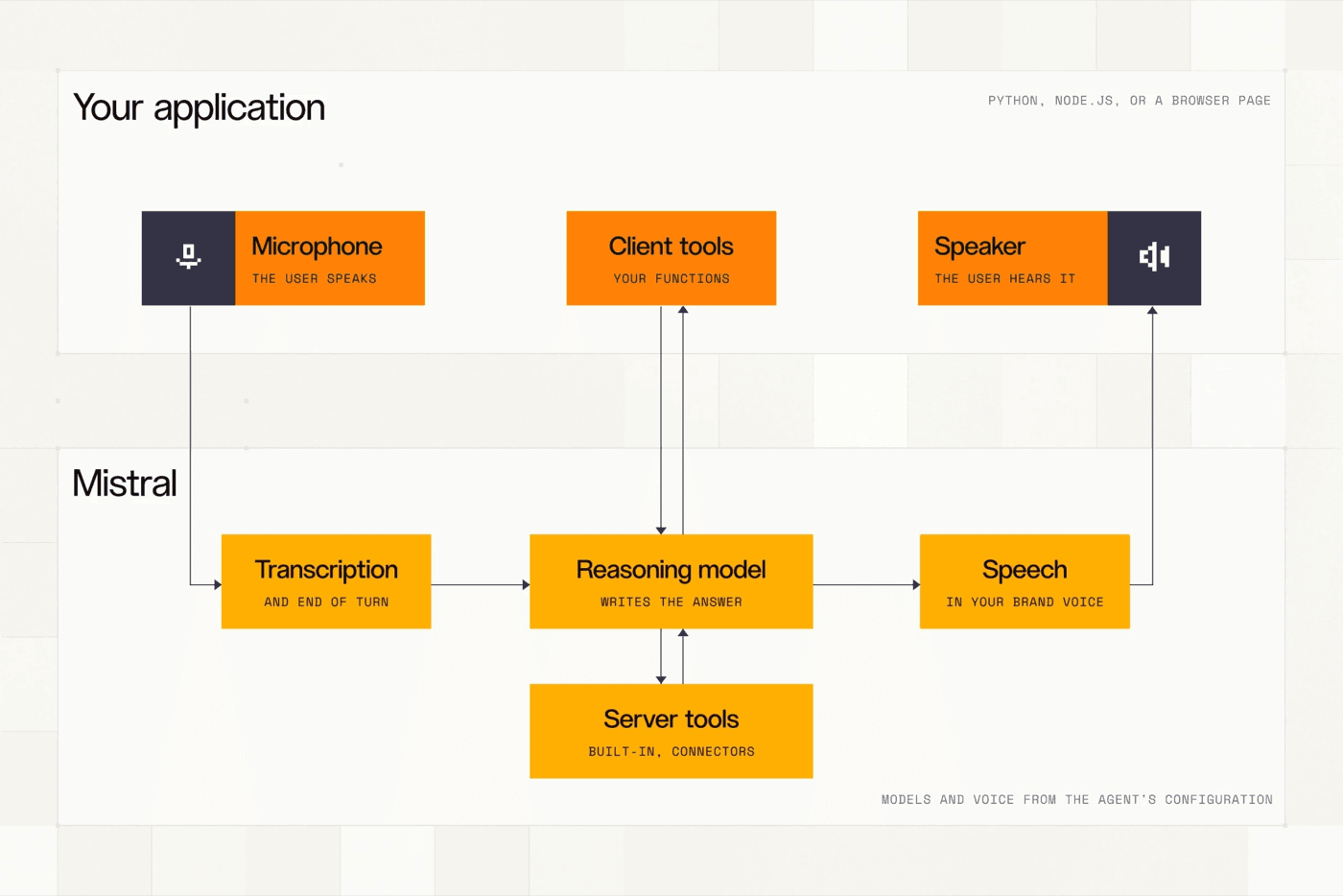
According to the voice agents docs:
- The SDK uses LiveKit, a real-time audio and video framework, for audio transport and adds Python, Node.js and browser TypeScript bindings. You don't need to know LiveKit to use it.
- Server-side tools (web search, document libraries and workspace connectors) run at Mistral. Client-side tools run your own functions in your app.
- An agent is a saved, versioned configuration with instructions, models, voice and tools, and a session is one live conversation started from it. Signed webhooks tell your backend when a call starts, ends or fails.
- SIP telephony (SIP is the standard protocol phone systems use to set up calls) is available to enterprise customers at launch through their account team. Client-side tools don't run on a phone line, so phone agents need server-side tools.
- If you need control over turn detection or where audio is processed, you can wire the realtime transcription, a chat model and streamed speech together yourself.
Because each stage is a separate model, Mistral says you can change the LLM, the voice or the language without rewriting the agent. For on-premises or private-cloud deployment of the whole stack, the announcement says to contact Mistral's team.
Voxtral 3 open weights and license
Voxtral 3 has no open weights. Every earlier Voxtral launch announced on Mistral's blog included at least one open-weight model. The first Voxtral models (24B and 3B) came out under Apache 2.0 on July 15, 2025. Voxtral Realtime followed under Apache 2.0 on February 4, 2026, and Voxtral TTS shipped weights under CC BY-NC 4.0 on March 23, 2026.
This time, the announcement never mentions open weights, the docs mark all the new models as "Premier" with no license listed, and Mistral's Hugging Face organization showed no Voxtral 3 checkpoints on October 21. "Self-deployment" in the launch post means a commercial arrangement with Mistral. If you need weights you can download today, the Apache 2.0 Voxtral Mini 4B Realtime is still available. For what running an open model locally involves, see our guide to running Meta Muse Spark Open on a Mac Studio.
Which Voxtral 3 model should you use?
- For recorded meetings, calls and interviews with several speakers, use Voxtral Small Transcribe 3. It posts the best diarization score in Mistral's chart for $0.0005 per minute more than Mini.
- For high-volume batch transcription, use Voxtral Mini Transcribe 3. It trails Small by about half a point of WER on FLEURS and costs $0.0035 per minute.
- For live captions or your own voice pipeline, use Voxtral Mini Transcribe Realtime 3 and pick the delay per session; 480 ms gave 6.4% WER in Mistral's test.
- For spoken output and cloned voices, use Voxtral TTS 3. Zero-shot cloning works from a short clip. For professional voice cloning, the voice cloning docs recommend 30 minutes to 3 hours of clean single-speaker audio. Plain-language style instructions are "not available at launch", so use the emotion and pace tags.
- For a full phone or web agent, use the voice agent SDK, at $0.04 per minute with Mistral Small 4. Benchmark it against Gemini's realtime transcription if accuracy on live speech matters most.
How to try Voxtral 3
- Open the Studio playgrounds, where Mistral lets you test voice agents, transcription, speech generation and voice cloning without code.
- Create an API key in Mistral AI Studio, install the SDK with
pip install "mistralai[realtime]"(the realtime extra adds the WebSocket client), and call the transcription endpoint/v1/audio/transcriptionsor the speech endpoint/v1/audio/speechwith one of the model IDs in the table above. - For a voice agent, start from the SDK quickstart in the voice agents docs. Install PortAudio for Python, or SoX and FFmpeg for Node.js, if the SDK can't capture or play audio.
- If your code calls Voxtral 2 models, follow Mistral's migration guide before switching model IDs.
All models are in public preview, so expect specs and docs to change.
FAQ
What is Mistral Voxtral 3?
Voxtral 3 is a family of speech AI models from Mistral AI, released on October 20, 2026. It includes Voxtral Small Transcribe 3, Voxtral Mini Transcribe 3 and Voxtral Mini Transcribe Realtime 3 for speech-to-text, Voxtral TTS 3 for text-to-speech, and a voice agent SDK built on LiveKit. All are available through the Mistral API in public preview.
How much does Voxtral 3 cost?
Mistral lists $0.0035 per minute for Voxtral Mini Transcribe 3, $0.004 for Voxtral Small Transcribe 3, $0.008 for Voxtral Mini Transcribe Realtime 3 and $13 per 1M characters for text-to-speech. The hosted voice agent API costs $0.04 per minute with Mistral Small 4 and $0.08 per minute with any other reasoning model.
Is Voxtral 3 open source?
No. Unlike earlier Voxtral models released under Apache 2.0 or CC BY-NC 4.0, Voxtral 3 has no public weights. Mistral's docs label the models "Premier", and running them on your own infrastructure requires contacting Mistral's sales team.
How many languages does Voxtral 3 support?
Per Mistral's language docs, Voxtral Small and Mini Transcribe 3 support 50 languages, Voxtral Mini Transcribe Realtime 3 supports 45 languages and dialects, and Voxtral TTS 3 supports 35 languages and more than 50 dialects. Preset voices are available in 18 languages.
Is Voxtral 3 more accurate than Whisper or Gemini?
In Mistral's FLEURS chart, Voxtral Small Transcribe 3 has a 4.0% word error rate with the language specified, against 14.9% for Whisper large-v3 and 4.5% for Gemini 3.5 Transcribe. In realtime transcription, Gemini 3.5 Realtime Transcribe (4.2%) beats Voxtral's realtime model (5.7% at its slowest setting). These are Mistral's own tests.
Sources
- Mistral AI: Voxtral 3 announcement
- Mistral AI news RSS feed (publication date)
- Mistral docs: Audio overview
- Mistral docs: Supported languages
- Mistral docs: Voice agents
- Mistral docs: Text to speech
- Mistral docs: Voice cloning
- Mistral docs: Voxtral Small Transcribe 3
- Mistral docs: Voxtral Mini Transcribe 3
- Mistral docs: Voxtral Mini Transcribe Realtime 3
- Mistral docs: Voxtral TTS 3
- Mistral AI: Voxtral (July 2025)
- Mistral AI: Voxtral Transcribe 2 (February 2026)
- Mistral AI: Voxtral TTS (March 2026)
- Hugging Face: Mistral AI models
- OpenAI: API pricing
- ElevenLabs: API pricing
- Deepgram: Pricing
- Google: Gemini API pricing
- AssemblyAI: Pricing
- Microsoft AI: MAI-Transcribe-2 announcement
- The Decoder: Mistral AI launches Voxtral 3
- Hacker News discussion