Kimi K3.1 Pro: Benchmarks, Pricing and Open Weights Date

Kimi K3.1 Pro is Moonshot AI's new flagship model, released on October 23, 2026, with full weights promised by November 4. In Moonshot's own tests it scores 65.7 on Terminal-Bench 4.0, less than a point behind Claude Opus 5.5 (66.4), and it costs $2 per million input tokens and $10 per million output tokens through the API. Independent tester Artificial Analysis puts it fourth of 215 models on its Intelligence Index, which would make it the highest-ranked model with downloadable weights once those weights ship. Until they land on Hugging Face, K3.1 Pro is an API model, and Artificial Analysis lists it as proprietary for that reason.
Key takeaways
- A post-trained version of Kimi K3, which Moonshot calls a "3T-class" model. K3's model card lists 2.8 trillion total parameters with 104 billion active per token, and a 1,048,576-token context window.
- Two API models:
kimi-k3.1-proandkimi-k3.1-pro-highspeed. Highspeed runs two to three times faster and costs twice as much. - Pricing is $2 input, $0.20 cached input, $10 output per million tokens, about a third cheaper than K3's $3 and $15.
- In Moonshot's charts it is first among the tested models on SWE Marathon (51.7), Agents' Last Exam (43.2), Humanity's Last Exam with tools (70.0) and OfficeQA Pro v2 (64.4); behind Claude Opus 5.5 and GPT-6 Astra on Terminal-Bench Science, BenchCAD and OSWorld.
- The claim-level hallucination rate on Moonshot's hardest internal test fell from 23.4% (K3) to 8.3%, measured with tools.
- Weights are due by November 4, 2026. The license for K3.1 has not been published.
What is Kimi K3.1 Pro?
Kimi K3.1 Pro is the first model in Moonshot AI's K3.1 series. Moonshot, a Beijing company founded in March 2023, released Kimi K3 in July 2026. K3.1 Pro keeps K3's base and adds what Moonshot's launch post describes as "substantially larger" post-training compute, the reinforcement-learning and fine-tuning stage that turns a pretrained model into an assistant that plans, uses tools and writes code.
Because K3.1 Pro is a post-trained K3, the architecture published in the Kimi K3 model card is the best public guide to what sits underneath. Moonshot has not published a separate spec sheet for K3.1 Pro, so treat the table as K3's numbers.
| Property | Kimi K3 (base of K3.1 Pro) |
|---|---|
| Total parameters | 2.8 trillion |
| Active parameters per token | 104 billion |
| Layers | 93 (1 dense) |
| Attention | 69 KDA (Kimi Delta Attention, a linear-attention variant) layers and 24 Gated MLA layers |
| Experts | 896 routed experts, 16 selected per token, plus 2 shared experts |
| Context window | 1,048,576 tokens |
A mixture-of-experts (MoE) model splits its feed-forward layers into many small sub-networks and sends each token through only a few of them. That is why a 2.8T-parameter model can run with the compute cost of a roughly 100B dense model. The mix of linear attention and full attention layers is what keeps a million-token context affordable.
Benchmarks: where K3.1 Pro leads and where it trails
Moonshot published 16 head-to-head results against Claude Opus 5.5, Claude Fable 5.1, GPT-6 Astra, DeepSeek V4.1 Flash 1017 and GLM-5.3. All models ran at maximum thinking effort. These are vendor-run numbers, so read them as Moonshot's claims until outside labs repeat them.
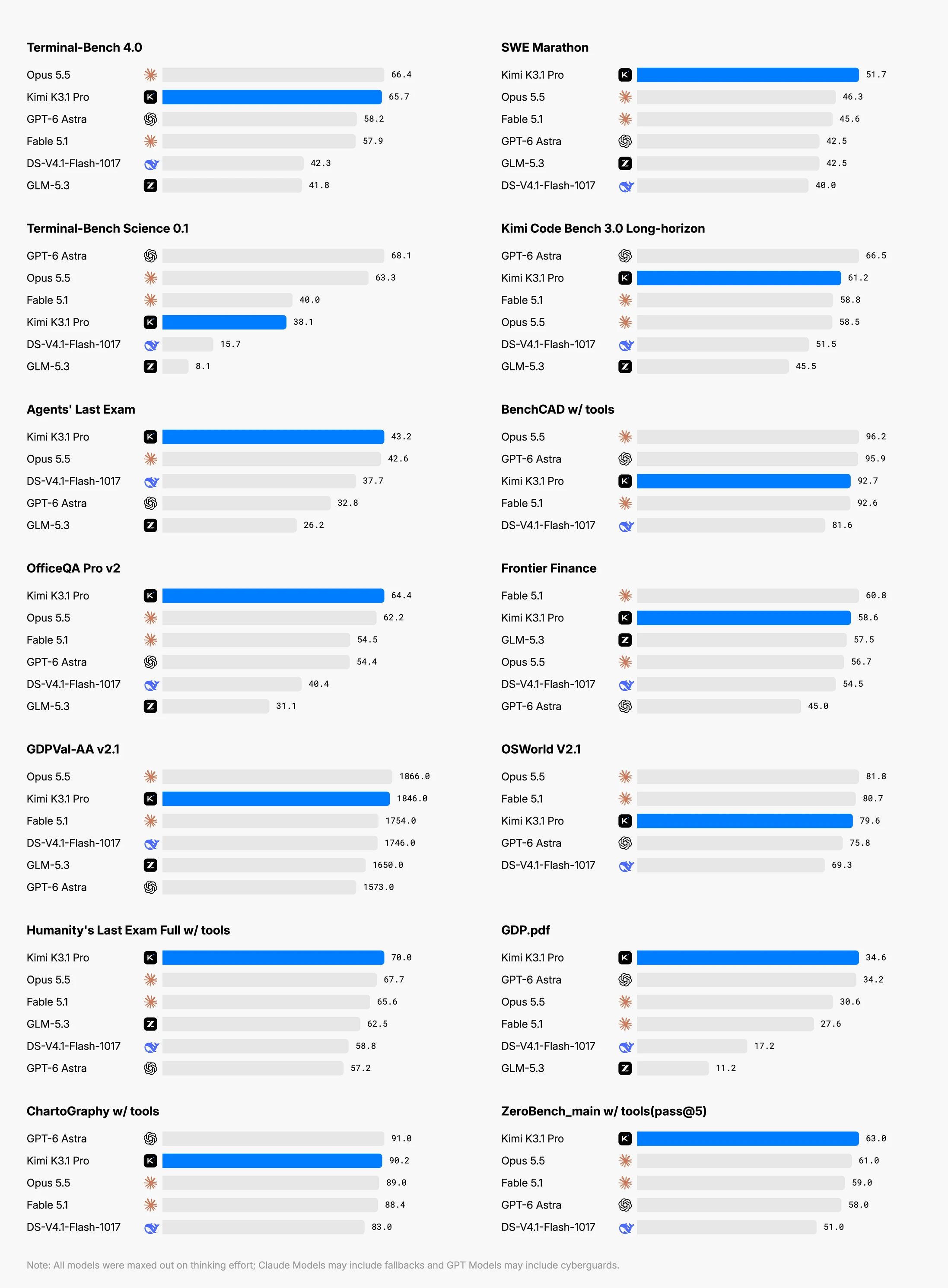
| Benchmark | Kimi K3.1 Pro | Claude Opus 5.5 | GPT-6 Astra | Top model in chart |
|---|---|---|---|---|
| Terminal-Bench 4.0 | 65.7 | 66.4 | 58.2 | Opus 5.5 |
| SWE Marathon | 51.7 | 46.3 | 42.5 | K3.1 Pro |
| Kimi Code Bench 3.0 (long-horizon) | 61.2 | 58.5 | 66.5 | GPT-6 Astra |
| Terminal-Bench Science 0.1 | 38.1 | 63.3 | 68.1 | GPT-6 Astra |
| Agents' Last Exam | 43.2 | 42.6 | 32.8 | K3.1 Pro |
| Humanity's Last Exam (full, with tools) | 70.0 | 67.7 | 57.2 | K3.1 Pro |
| OfficeQA Pro v2 | 64.4 | 62.2 | 54.4 | K3.1 Pro |
| GDPVal-AA v2.1 (Elo) | 1846 | 1866 | 1573 | Opus 5.5 |
| OSWorld V2.1 | 79.6 | 81.8 | 75.8 | Opus 5.5 |
| BenchCAD (with tools) | 92.7 | 96.2 | 95.9 | Opus 5.5 |
Moonshot's numbers show three patterns.
- Long agentic work is the strength. SWE Marathon and Agents' Last Exam both reward models that keep a plan together over many tool calls, and K3.1 Pro tops both. The long-horizon version of Moonshot's own coding test rose from 55.95 on K3 to 61.2.
- Science and computer use are the gaps. On Terminal-Bench Science, K3.1 Pro scores 38.1 against GPT-6 Astra's 68.1, the widest gap in the chart. It also trails both Claude models on OSWorld, which tests operating a desktop.
- Office and finance tasks improved the most. Moonshot reports 64.4 on OfficeQA Pro v2, and its internal "business operation" score jumped from 8.9 on K3 to 37.
For outside confirmation, Artificial Analysis scores K3.1 Pro at 55 on its Intelligence Index, fourth of 215 models, up from 44 for K3. The same page measures 80.7 output tokens per second on Moonshot's API. For context on the models it is compared with, see our Gemini 4 Argon benchmark breakdown and DeepSeek V4.1 Flash 1017 review.
Fewer hallucinations, with a caveat
Moonshot says the claim-level hallucination rate on its Kimi Hallu Bench Hard fell from 23.4% for K3 to 8.3% for K3.1 Pro, measured with tools such as web search. A claim-level rate counts the share of individual factual statements in an answer that contain errors, rather than marking a whole answer right or wrong. Lower is better.
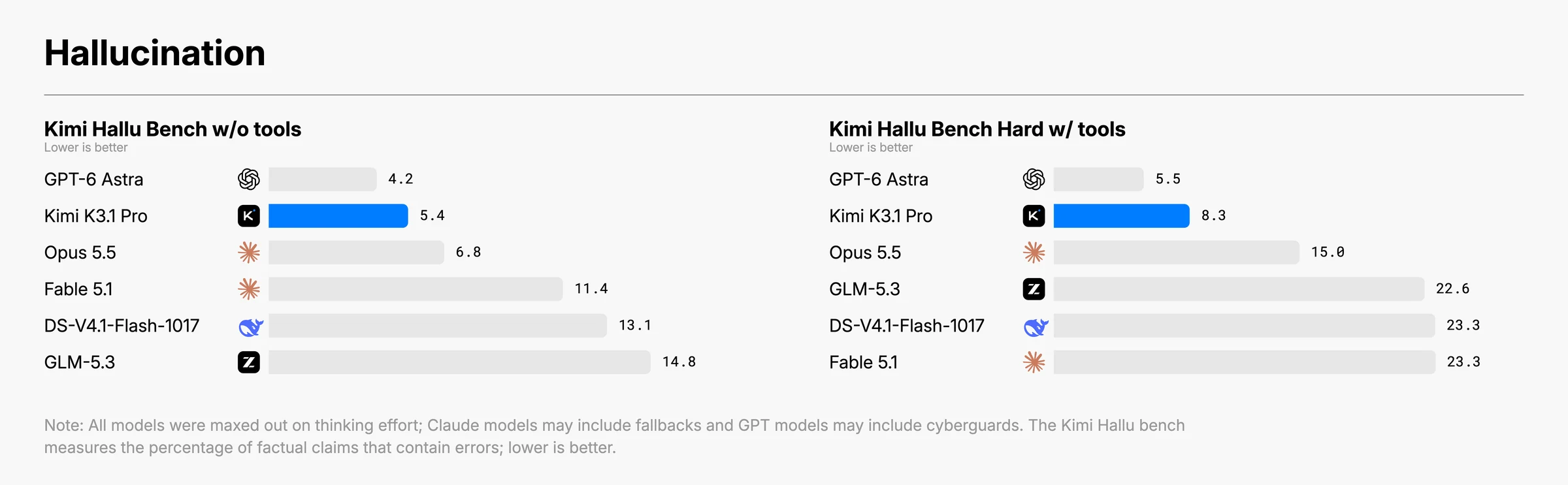
On the Hard set with tools, K3.1 Pro (8.3%) beats Claude Opus 5.5 (15.0%) but not GPT-6 Astra (5.5%). On the standard set without tools the order is the same: GPT-6 Astra 4.2%, K3.1 Pro 5.4%, Opus 5.5 6.8%. Both are Moonshot's own benchmarks, so nobody outside the company has checked them yet.
The cybersecurity trade-off
The most debated part of the launch is a capability Moonshot weakened on purpose. The company says it stripped cyber-related data from the mid-training and reinforcement-learning stages of the model it will release as open weights. On its xdev-bench-hard exploit-development test, K3.1 Pro scores 81.0% at pass@3, while the same checkpoint without those risk-reduction measures scored 90.5%.
Moonshot's argument is that open weights cannot be recalled, so the downloadable model should stay behind closed models that have been public for at least three months. In the Hacker News thread on the launch, which passed 750 points, this was the main dispute. Some readers called it a handicap for defenders, others called it a responsible default. Security teams that rely on models for vulnerability research should test it on their own tasks before switching.
Kimi K3.1 Pro pricing and API access
K3.1 Pro is live in the Kimi web and mobile apps, the Kimi Work desktop app, Kimi Code (selected with /model) and the Kimi API. Business and Enterprise admins have to switch it on, since it is off by default.
| Model | Input (cache miss) | Cached input | Output | Speed |
|---|---|---|---|---|
| kimi-k3.1-pro | $2.00 | $0.20 | $10.00 | Baseline |
| kimi-k3.1-pro-highspeed | $4.00 | $0.20 | $20.00 | 2 to 3 times faster |
| kimi-k3 (previous) | $3.00 | $0.30 | $15.00 | Not listed |
Prices are per million tokens, from Moonshot's endpoint listing on OpenRouter and matched by Artificial Analysis; K3 prices are from the K3 launch post. There is no long-context surcharge.
A few API details from the K3.1 Pro quickstart matter for cost planning:
- Thinking mode is always on. You can set
reasoning_effortto low, high or max, and the default is max. max_completion_tokensdefaults to 131,072. Long reasoning traces count as output tokens, so set a lower cap if you are price-sensitive.- Temperature (1.0) and top_p (0.95) are fixed.
- The API is OpenAI-compatible at
https://api.moonshot.ai/v1, and an Anthropic-compatible Messages endpoint athttps://api.moonshot.ai/anthropiclets tools built for Claude switch with a base-URL change. - Zero Data Retention is available for API customers.
Because max effort is the default, the real cost per task can be well above what the per-token price suggests. Several Hacker News commenters said earlier Kimi models produced long outputs, so measure tokens per task as well as price per token before comparing it with Claude or GPT.
Open weights: what to expect on November 4
Moonshot says "the full model weights will be released by Nov 4." K3 followed the same pattern: launched July 16, weights on Hugging Face shortly after.
K3 ships under the Kimi K3 License, an MIT-style license with two commercial conditions:
- Model-as-a-service providers whose annual revenue, including affiliates, exceeds $20 million need a separate agreement with Moonshot.
- Commercial products with more than 100 million monthly active users or more than $20 million in monthly revenue must display "Kimi K3" prominently in the interface.
Moonshot has not said whether K3.1 will use the same terms, so check the license file when the weights appear. Running a 2.8T-parameter model yourself needs a multi-GPU server. If you want a model that fits on a laptop, a small MoE like Recursive Flint is closer to that use case.
Who should try it
- Teams running long agent jobs (multi-step coding, research, document work) have the clearest case: near-Opus results on Terminal-Bench at a lower list price.
- Companies that need self-hosting for data control should plan around the November 4 weights and the license terms.
- Science-heavy and computer-use workloads are better served by GPT-6 Astra or Claude Opus 5.5 on Moonshot's own numbers.
- Security researchers should expect a deliberately weaker model on exploit work.
FAQ
Is Kimi K3.1 Pro open source?
Not yet. Moonshot says the full weights will be released by November 4, 2026. Its predecessor, Kimi K3, is on Hugging Face under the Kimi K3 License, an MIT-style license with conditions for very large commercial users. The K3.1 license has not been published.
How much does Kimi K3.1 Pro cost?
Through Moonshot's API, Kimi K3.1 Pro costs $2 per million input tokens, $0.20 per million cached input tokens and $10 per million output tokens. The Highspeed variant costs $4 and $20 and runs two to three times faster. Both are cheaper than Kimi K3, which was $3 and $15.
How does Kimi K3.1 Pro compare with Claude Opus 5.5?
On Moonshot's charts, K3.1 Pro is within a point of Claude Opus 5.5 on Terminal-Bench 4.0 (65.7 vs 66.4) and ahead on SWE Marathon, Agents' Last Exam and Humanity's Last Exam with tools. Opus 5.5 leads on OSWorld, BenchCAD and Terminal-Bench Science. Artificial Analysis ranks K3.1 Pro fourth of 215 models.
What is the difference between K3.1 Pro and K3.1 Pro Highspeed?
They are the same model family served at different speeds. Moonshot says Highspeed delivers two to three times the output speed of K3.1 Pro at double the input and output price. The cached-input price is the same, $0.20 per million tokens.
How big is Kimi K3.1 Pro?
Moonshot calls it a "3T-class" model built by post-training Kimi K3. K3's model card lists 2.8 trillion total parameters with 104 billion active per token and a context window of 1,048,576 tokens.
Sources
- Moonshot AI: Kimi K3.1 Pro launch post
- Moonshot AI: Kimi K3 launch post
- Kimi API: K3.1 Pro quickstart
- Kimi API: Anthropic-compatible Messages endpoint
- Hugging Face: Kimi K3 model card
- Hugging Face: Kimi K3 License
- Artificial Analysis: Kimi K3.1 Pro
- OpenRouter: Kimi K3.1 Pro
- Hacker News discussion of the launch