Mistral Large 4 Open Weights: Specs, Benchmarks, License
Mistral Large 4 open weights went public on October 29, 2026. The model is a 1-trillion-parameter mixture-of-experts with about 52B active parameters per token, and it now sits on Hugging Face under a modified MIT license. It arrives with better coding and agent scores than the API-only preview Mistral shipped three weeks earlier.
Running it yourself still takes an 8-GPU server, and on aggregate benchmarks it trails the best Chinese open models. This post covers the changes since the preview, the comparison with other open models, the license terms and the self-hosting options.
Key takeaways
- Mistral shipped the full weights of Mistral Large 4 (
mistralai/Mistral-Large-4-1T-A52B), a 1T-total, 52B-active MoE with image input and a 1M-token context window, plus an NVFP4 checkpoint and GGUF quantizations. - Three extra weeks of reinforcement learning lifted Terminal-Bench 4.0 from 28.3% to 41% and cut output tokens by 30%, according to Mistral.
- It ties GLM-5.3 on the Artificial Analysis Coding Agent Index (48% vs 49%) but scores 26 on the Intelligence Index v5, behind GLM-5.3 and DeepSeek V4.1 Flash at 32.
- The license allows free use, modification, fine-tuning and commercial use; only companies selling the model as a hosted service need a separate commercial license.
- On the API it costs $0.70 per million input tokens, $0.07 cached and $2.10 output.
What is Mistral Large 4?
Mistral Large 4 is Mistral AI's flagship model, nicknamed "Le Chonk." It is an open-weight, hybrid instruct-and-reasoning mixture-of-experts (MoE) model that accepts text and images and returns text. Mistral first opened it as a paid API preview on October 6, 2026 and promised the weights by the end of the month. It kept that promise with two days to spare.
A mixture-of-experts model splits its feed-forward layers into many small "experts" and routes each token through only a few of them. That is why a model with a trillion parameters can run with the compute cost of a much smaller one: per the Hugging Face model card, each token uses 49B parameters, or 52B when the embedding and output layers are counted.
Specs at a glance
| Item | Mistral Large 4 |
|---|---|
| Total parameters | 1.05T (Mistral docs) |
| Active parameters | 49B per token, 52B with embedding and output layers |
| Experts | 128 routed experts, 4 active per token, plus 1 shared expert |
| Context window | 1M tokens |
| Input | Text and images (1.6B-parameter vision encoder) |
| Languages | 160+, including all official EU languages |
| Reasoning modes | Low, medium, high (default) |
| Training hardware | 3,800 NVIDIA Grace Blackwell GPUs in Mistral's European datacenters |
| API price (per 1M tokens) | $0.70 input, $0.07 cached input, $2.10 output |
The reasoning setting replaces the old "none" mode with "low." Mistral recommends high for agentic and hard prompts, medium for everyday use and low for quick chat replies. Reasoning tokens count toward max_completion_tokens, so a high-effort call can use up its budget before it writes a visible answer.
What changed between the preview and the open release?
The open checkpoint is not the same model Mistral served in early October. Mistral says it ran three more weeks of reinforcement learning, and most agent and coding numbers moved up.
| Benchmark | October 6 preview | October 29 open weights |
|---|---|---|
| Terminal-Bench 4.0 | 28.3% | 41% |
| B3 agent security (attack resistance) | 93.3% | 97.1% |
| FinWorkBench (Finch) | 67.4% | 73.3% |
| BrowseComp | 75% (early SFT checkpoint) | 84.5% |
Sources: Mistral preview post and Mistral open-weights post. All figures are self-reported by Mistral.
Terminal-Bench measures whether a model can finish real tasks in a command-line environment, so the 13-point gain is the change coding-agent builders will notice most. Mistral also says the open model produces 30% fewer output tokens on that benchmark, which lowers cost per task on top of the score gain.
How does Mistral Large 4 compare with other open-weight models?
Mistral Large 4 is competitive on coding agents and security but not the top open model overall. The fairest summary comes from the two Artificial Analysis charts Mistral published on the model card.
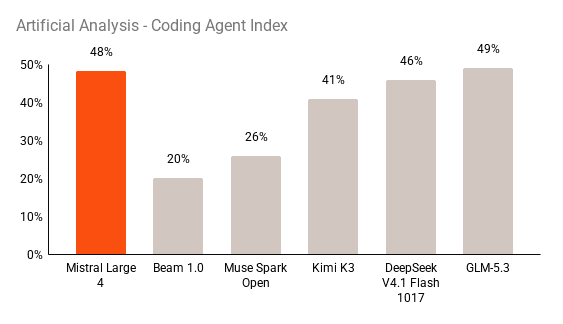
On the Coding Agent Index, Mistral Large 4 scores 48%, against 49% for GLM-5.3, 46% for DeepSeek V4.1 Flash 1017 and 41% for Kimi K3. Mistral adds that it uses 47% fewer tokens per task than GLM-5.3 on average, which is the more useful number if you pay per token.
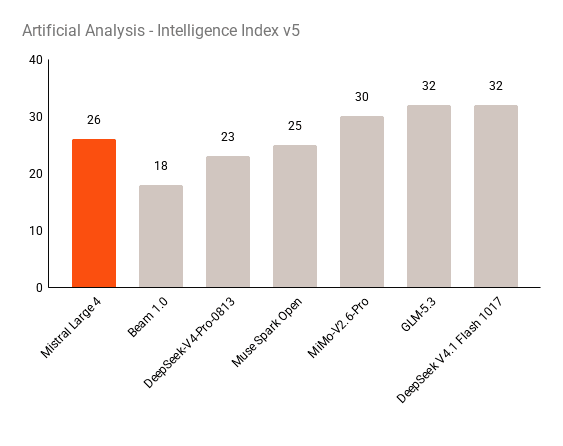
The broader Intelligence Index v5 tells a different story. Mistral Large 4 scores 26, ahead of Meta's Muse Spark Open (25) but behind MiMo-V2.6-Pro (30), GLM-5.3 (32) and DeepSeek V4.1 Flash 1017 (32). Mistral itself concedes that leading Chinese open-weight models score higher on this aggregate. If you followed our coverage of DeepSeek V4.1 Flash, that model is still the stronger general-purpose pick at a much smaller size.
| Benchmark | Mistral Large 4 | Kimi K3 | GLM-5.3 | DeepSeek V4.1 Flash 1017 |
|---|---|---|---|---|
| AA Coding Agent Index | 48% | 41% | 49% | 46% |
| AA Intelligence Index v5 | 26 | n/a | 32 | 32 |
| BrowseComp | 84.5% | 91.2% | 82.5% | 83.4% |
| FinWorkBench | 73.3% | 77.3% | 65.1% | n/a |
| Malicious cyber request refusal | 97% | 94% | 87% | n/a |
Source: charts in the Mistral open-weights post and model card. "n/a" means Mistral did not chart that model on that benchmark.
On Cognition's private FrontierCode 2.0 benchmark, Mistral Large 4 scores 19.7%, the best open-weight result in Mistral's chart. In Surge's blind human preference test for code, raters preferred it over GLM-5.3, Kimi K3 and DeepSeek V4.1 Flash, and only Claude Opus 5.5 ranked ahead. For the Kimi side of this comparison, see our breakdown of Kimi K3.1 Pro.
Why is Mistral pitching it for cybersecurity?
Mistral is selling Large 4 as a security model as much as a coding model. It scores 51% on the Artificial Analysis Cyber Index, which tests finding, reproducing, validating and patching vulnerabilities without breaking the software. At the same time, Mistral reports a 96.6% average refusal rate on malicious cyber requests across JailbreakBench, StrongREJECT and AgentHarm, the highest it measured among open models.
Security teams at banks and governments often cannot send code to a US API, and an open model they can run on their own hardware fits that constraint. Mistral lists Cisco, CrowdStrike, Fortinet, Zscaler, Cloudflare and ENISA among partners, and a specialized cyber variant is in preview with Orange Cyberdefense for vetted penetration testing on authorized systems only.
Mistral's post also says the model refused black-box attacks on live targets in testing but showed "a potential for uplift to real attacks," and that it is changing its guardrails in response.
What does the Mistral Ecosystem Open-Weight License allow?
The license is a modified MIT license. You can use, modify, fine-tune and commercialize Mistral Large 4 without paying Mistral, with one exception: a business that offers the model as a hosted service (Model-as-a-Service) must get a separate commercial license. The full text is in the LICENSE file on Hugging Face.
A company running the model internally, building it into its own product or fine-tuning it on private data needs no extra license. An inference provider or cloud that resells access to Mistral Large 4 as an API does.
There is no cap on monthly active users, but the hosting clause means it is not Apache 2.0. Read the LICENSE file before you build a hosting business on it.
How do you run Mistral Large 4 yourself?
Self-hosting is realistic only on a multi-GPU server. Every example on the model card uses tensor parallelism across 8 GPUs, and Mistral does not publish a minimum memory figure. As a rough estimate of our own, the main checkpoint is tagged FP8, which works out to about one byte per parameter, so expect on the order of a terabyte of weights before the KV cache.
Supported paths, per the model card:
- vLLM: a dedicated image,
vllm/vllm-openai:mistral-large-4, with--tensor-parallel-size 8and Mistral's tool-call and reasoning parsers. - SGLang:
lmsysorg/sglang:mistral-large-4with--tp-size 8. - Transformers: install from the main branch and launch with
torchrun --nproc-per-node 8. - NVFP4: a smaller NVFP4 checkpoint for Blackwell GPUs.
- GGUF: quantizations for llama.cpp, linked from the model page.
Mistral also ships a speculative decoding head called DSpark. It adds three small dense layers that draft tokens ahead of the main model, and Mistral reports up to 1.9x throughput depending on hardware and workload. Recommended sampling is temperature=1.0 and top_p=0.95 at every reasoning level.
If you do not have the hardware, the model is on the Mistral API, OpenRouter, NVIDIA's hosted endpoints and NIM containers, and Microsoft Foundry, which Mistral calls the first cloud provider to offer it.
Who should care?
European and regulated buyers get the most obvious benefit. Mistral trained the model from scratch on its own European infrastructure, and La Banque Postale, one of the quoted customers, calls technological sovereignty "a key prerequisite."
Teams building coding or security agents are the second group. The Terminal-Bench and Coding Agent Index results, plus lower token use, make it a credible open alternative for agent workloads.
Fine-tuners are the third. Mistral offers its Forge service for fine-tuning on private data, but the weights also work with standard tooling.
If you need the best general reasoning per dollar and do not care where the model comes from, the Chinese open models above still lead. Mistral's earlier Voxtral 3 speech release shows the same strategy: compete on openness and deployment control rather than on the top aggregate score.
FAQ
Is Mistral Large 4 really open source?
It is open-weight, not open source in the strict sense. The weights are downloadable under the Mistral Ecosystem Open-Weight License, a modified MIT license, but the training data and full training code are not released, and companies selling it as a hosted API need a separate commercial license.
How many GPUs do I need to run Mistral Large 4?
Mistral's official vLLM, SGLang and Transformers examples all assume 8 GPUs with tensor parallelism. An NVFP4 checkpoint for NVIDIA Blackwell GPUs reduces memory use, and GGUF quantizations exist for llama.cpp, but it still needs server-class hardware.
How much does Mistral Large 4 cost on the API?
On the Mistral API it costs $0.70 per million input tokens, $0.07 per million cached input tokens and $2.10 per million output tokens, according to Mistral's documentation.
Is Mistral Large 4 better than DeepSeek or Kimi?
It depends on the task. It beats Kimi K3 on the Artificial Analysis Coding Agent Index (48% vs 41%) but trails Kimi K3 on BrowseComp (84.5% vs 91.2%), and it scores 26 on the Intelligence Index v5 against 32 for DeepSeek V4.1 Flash 1017. All of these figures come from Mistral's own charts.
What is the context window of Mistral Large 4?
Mistral Large 4 supports a 1-million-token context window and accepts both text and images as input, according to the Hugging Face model card and Mistral's documentation.
Sources
- Mistral AI: Releasing the weights of Mistral Large 4
- Mistral AI: Mistral Large 4 preview announcement (October 6, 2026)
- Hugging Face: mistralai/Mistral-Large-4-1T-A52B model card
- Hugging Face: Mistral Large 4 NVFP4 checkpoint
- Mistral Docs: Mistral Large 4 model page
- Hugging Face: Mistral Ecosystem Open-Weight License
- Hacker News discussion: We're releasing the weights of Mistral Large 4